FDNY Deputy Chief John Feehan ’16, ’20 Remembers the Father He Lost on 9/11
Current Role: FDNY Deputy Chief, Division 15; Adjunct Professor/Instructor, Fire Science and Fire Service Administration
John Jay Degrees: B.S. in Fire Service Management/Public Administration, M.S. in Emergency Management
Graduate Degree: D.Sc. in Emergency Management, Jacksonville State University
Military Rank: Petty Officer Third Class, U.S. Naval Reserve
Mentors: Charles P. Nemeth, Ph.D., former Chair and Professor of Security, Fire, and Emergency Management; Paul C. Kearns, Jr., Lecturer, Fire Science Program; the late FDNY Chief Ronald R. Spadafora, former John Jay Adjunct Lecturer, Emergency and Disaster Management Graduate Program
Hometown: Queens, NY
What was life like before John Jay?
I was born and raised in Flushing, Queens, the youngest of four siblings, in an Irish Catholic family. I was always around the fire service field because my father (First Deputy Fire Commissioner William M. Feehan) had quite a career with the FDNY. I always saw my father’s love for the job. It was clear that it meant a lot to him. He loved being part of something that was bigger than himself.
What happened on 9/11?
I was studying for my promotional exam to qualify for the lieutenant’s rank and I called my father to ask him about a bibliography for the test. He was at work, at the command post right in front of the Twin Towers. I was busting his chops a little bit. That was the last time I spoke to him, around 8:40 in the morning.
At home in Queens, I saw a big cloud of smoke in the sky. When you’re a firefighter, if you see smoke, you instinctively react. I turned on NY1 and saw that a plane had hit the North Tower. The Fire Department issued what they call a “recall”—which meant all firefighters needed to report to their station. They knew the magnitude of it fairly quickly.
Just as we were about to leave the station and head to the Towers, we heard the collapse of the first building. Immediately, my mind started racing, thinking about my father.
We sped to Manhattan and parked on Beekman Street, a quarter mile from the Trade Center. That was as close as we could get. On foot, we headed down Broadway, and the second building came down. The thick plume of debris quickly turned day into night. We grabbed people on the street and dove into a little electronics store.
I had to find my father. It was unbelievably quiet. I saw a firefighter I knew and asked him what was going on. I’ll never forget his response: “They’re all gone.”
I couldn’t process what he was saying, so I kept trying to find my father. A lot of the firefighters I encountered couldn’t bring themselves to tell me what happened, and I don’t blame them for that. Around 2:30 that afternoon, Chief Rod O’Connor from the 57th Battalion, a good family friend and neighbor, told me, “John, we lost him.”
Another chief told me they had my father’s body in an ambulance, which sounds awful, but we were luckier than most just by having his body. I went into the ambulance and said a prayer over my father. I wish I had stayed with him in the ambulance to go to the morgue, but I left him to tell my family in person. I returned to the site six days later, after his funeral. Hundreds of brave men and women worked day and night.
What do you want people to know about your father?
He was the kindest, smartest man I’d ever met. On September 11, he was 72 years old and still contributing to the FDNY. You’d never think that he was 72 because he always kept himself active. He always saw the better side of everything. The trait that I try to emulate the most is his willingness to help everyone. We don’t become firefighters to enhance ourselves. We’re given a very sacred task to take care of the public and our fellow firefighters. That’s who he was.
How do you teach the significance of 9/11 to your students?
The classes I teach are in emergency management or fire science, so there’s an obvious connection. Since most of the students are interested in the emergency services field, they tend to be a captive audience. Even though they were not alive in 2001, 9/11 was a seminal moment in emergency services, not only in New York City, but around the world.
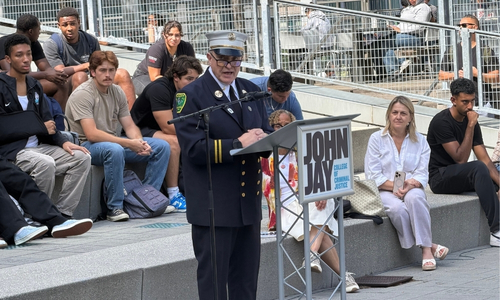
I ask the students to pick someone we lost on September 11th and write a paragraph about that person. It doesn’t have to be a firefighter; it could be anyone, someone who worked at Cantor Fitzgerald or a flight attendant. Understanding that one person’s story, putting a face to the tragedy, opens their eyes a bit and shows them the magnitude of what happened that day. We also cover why the buildings collapsed, the response, and technical aspects of the event, but the main thing I want them to take away is that everyone we lost on 9/11 was a lot more than that day. They were beautiful men and women with families, hobbies, interests, and dreams.
In my company, Squad 252, we lost six firefighters. I never want to forget them. I want the next generation to know that we have to be careful that another 9/11 doesn’t happen again. Certain things are out of our control, but training and being the best firefighters may help us avoid it. My father would certainly want students to remember.