
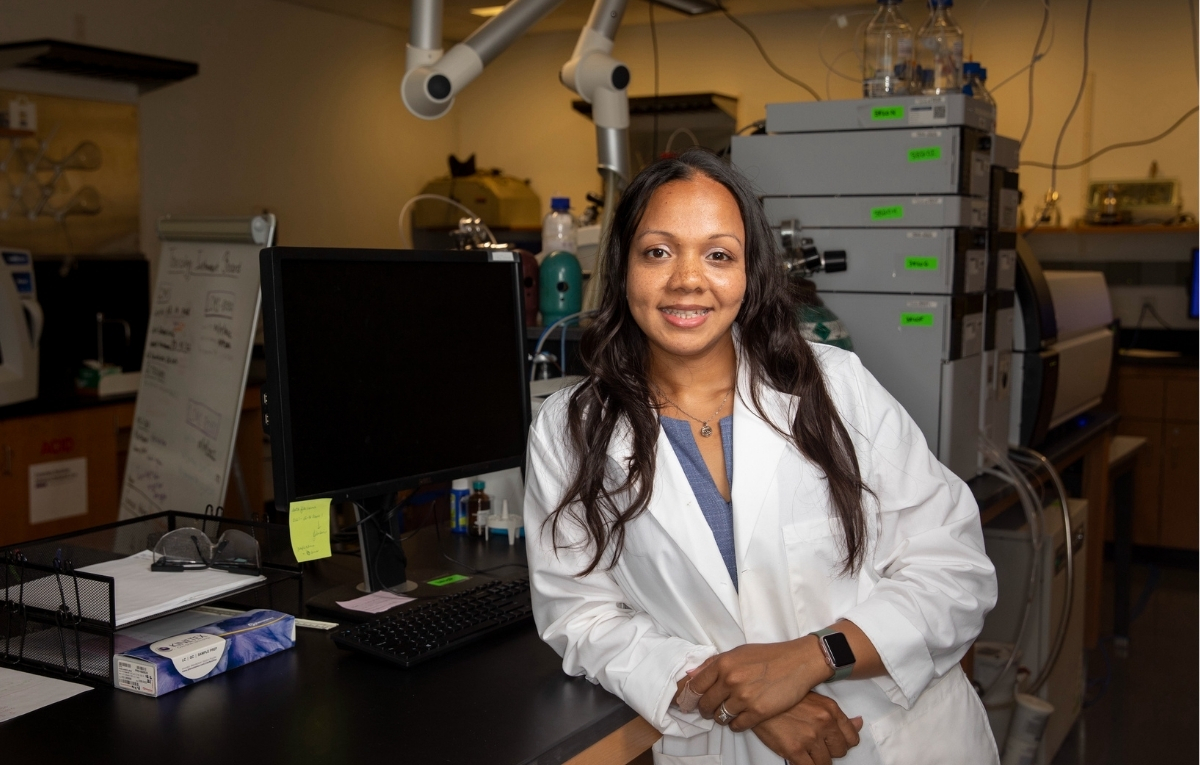
Teeshavi Acosta ’10, ’13 Earns a Ph.D. in Toxicology
Current Role: Head Toxicology Technician & Adjunct Assistant Professor, Department of Sciences, John Jay College
Post-graduate Degree: Doctor of Philosophy in Toxicology, St. John’s University (2026)
John Jay College Degrees: B.S. in Forensic Science, with a concentration in Toxicology (2010); M.S. in Forensic Science, with a concentration in Toxicology (2013)
Internship: NYC Office of Chief Medical Examiner (OCME)
Mentors: Yi He, Ph.D., Professor, Department of Sciences; Shu-Yuan Cheng, Ph.D., Associate Professor, Department of Sciences; Marta Conchiero-Guisan, Ph.D., Associate Professor, Toxicology
Program: PRISM (Program for Research Initiatives in Science & Math)
Hometown: Queens, NY
Career Aspiration: Toxicologist/Educator
What was life like before John Jay?
My family is from Guyana. My mom came to this country when she was pregnant with me, settling in Queens, New York. That’s where I’ve lived all my life. Immediately after arriving in New York, mom started working, holding down two jobs while going to night school. She wanted to set herself up with a good-paying job so she could take care of me.
I’m an only child, but I didn’t have a lonely childhood. My grandparents lived just five minutes away and helped raise me. They were my everything. My grandfather was my hero. He was such a strong and smart man, who worked as a narcotics detective and dedicated his life to helping communities and supporting his family. Even in his final days, he taught me that in life, you must keep pushing forward. I grew up spending my summers visiting Guyana with them. The town my grandparents were from was very poor and severely underserved. They had frequent blackouts, and people had to get water from a well for their outhouses, but everyone in that town was so happy just to exist. That’s one of the biggest takeaways from my visits to Guyana and growing up with my grandparents—always remain humble and grateful.
I also grew up idolizing my mom. She was a fierce, independent woman who charted her own course and worked as an investment banker at Chase. Some of my earliest memories involve watching her get ready for work. She’d put on her suit and shoes, and you would just see this powerful, Alpha woman come to life. The drive to do good work and be a productive member of society is a trait she passed on to me. She pushed me to be and do better. It’s one of the reasons I did well academically and was the first in my family to go to college.
What sparked your passion for the sciences?
My interest in science, and eventually forensics, was shaped by my grandfather. He served as a narcotics detective in Guyana for 40+ years and was highly respected in his field. Growing up, he often spoke about the impact drugs have on individuals and communities, and he regularly visited local schools to educate students about the dangers of drug use. Some of my favorite memories are of sitting on his lap watching shows like Cops on TV. After each episode, he explained why the person was arrested and the crime they committed. If the crime involved drugs, he explained the chemistry behind the drug, its properties, and why the drug was so dangerous. Those conversations sparked a fascination with chemistry and forensic science that has stayed with me since.
Why John Jay?
Originally, I was supposed to go to a SUNY college upstate for forensic chemistry, but then my mom found out she had multiple brain aneurysms and needed surgery. Eventually, she was diagnosed with Ehlers-Danlos Syndrome, an inherited, genetic disorder that affects mobility, causes pain and fatigue, and creates instability. Wanting to stay close to home and help my mom, I decided to attend a college in the city. John Jay’s standing as a top criminal justice school is what drew me to the College. I knew I wanted to do something involving law and forensics because of my grandfather’s work in law enforcement, and the forensic science program felt like the perfect place for me to learn and grow into the scientist I wanted to be.
How did your mentors shape your career aspirations and prepare you for success?
Collectively, all three women, Dr. He, Dr. Cheng, and Dr. Cocheiro-Guisan, have been so important to my life and my career. It was an instrumental analysis course I took with Dr. He that ignited my passion for toxicology. I thought her research was interesting and wanted to work in her lab. Early in the course, she said that if I got an A, I could conduct research with her. I remember that I was given a vial and, using my knowledge of chemistry and instruments, had to identify a drug, determine its danger level, detect potential contamination in the sample, and assess what the drug meant for the situation we were investigating. The analytical work was endlessly fascinating to me, and I was hooked. I fell in love with the process, the instruments, and toxicology. I went on to earn an A in the course and conducted research with Dr. He.
During my master’s program in forensic science at John Jay, I worked in Dr. Cheng’s lab. I learned so much under her guidance. The time I spent in her lab strengthened my discipline, sharpened my time management and research skills, and taught me how to communicate scientific findings effectively. It also deepened my appreciation for collaborative research. Watching Dr. Cheng rise the ranks and become Chair of the Department of Sciences was especially meaningful. It was a well-deserved achievement and showed me that women can pursue bold ambitions and lead at the highest levels of academia. Her mentorship has had a lasting impact on both my professional development and my confidence in what I can achieve.
As a grad student, I began teaching at John Jay. Following the experience, I knew that teaching would be part of my future. I also dreamt of earning a doctorate. But to make that dream a reality, I needed to earn my Ph.D., and that’s when Dr. Concheiro-Guisan stepped in. She said I would need published research on my resume to get into a doctoral program and offered me a spot in her lab. At the time, I didn’t understand the importance of publishing in the academic space, and she helped me understand. We started a project, she assigned me tasks, and we wrote a paper together. That one paper led to multiple papers. Her mentorship has meant so much to me. One of the things I love about working with Dr. Concheiro-Guisan is that she doesn’t hold your hand in the lab. She tells it like it is. She lets you know if you’re doing something wrong, points you in the right direction, but allows you to figure things out on your own. You grow not only as a person but also as a scientist.
What was especially inspiring about these three women was that they were amazing scientists and also incredible wives and mothers. It was through their examples that I learned what was possible as a woman in STEM.
What drew you to the doctoral program in toxicology at St. John’s University?
St. John’s has one of the country’s strongest toxicology Ph.D. programs, so it quickly became my top choice. I was also aware that several members of the John Jay faculty, including Dr. Cheng, hold a Ph.D. from St. John’s, so I knew the program produced very successful toxicologists. After talking it over with my husband—since this would cause financial stress for our family and he would have to take on more childcare responsibilities at home—I applied and was thrilled to be accepted. At St. John’s, I gained hands-on experience in cell-based research, chemical analysis, and the study of how chemicals affect biological systems. The training helped shape me into a well-rounded toxicologist.
How did your John Jay education help prepare you for your doctoral program?
John Jay gave me the strong analytical foundation I needed to succeed in my Ph.D. program. One thing I noticed right away was that I had an advantage over my classmates when it came to documentation. Because it’s a criminal justice school, at John Jay, you’re taught to write everything down and keep detailed notes, and that mindset stayed with me at St. John’s. Some of my peers in the doctoral program hadn’t developed those skills yet, but for me, it was second nature. I had several notebooks filled with research notes. Even today, I have a sign in my lab that says, “Did you document it?” because in toxicology, good documentation is everything.
What has the experience been like teaching at John Jay?
It feels like a beautiful full-circle moment. I’ve been teaching at John Jay for over 14 years now, and I’ve cherished every minute. I love connecting with students, especially in the lab. I love seeing their eyes light up when they learn something new or understand how to use an instrument. It fills me with joy to see them “get it.” They are the reason I come to work every day with a smile on my face.
Where do you see yourself in 10 years?
My greatest wish is to give back to this John Jay community that means so much to me. I’m a proud product of John Jay and CUNY. Getting to see our science programs grow and progress, being an active participant in that expansion, and seeing our students go out into the world and succeed, is the most fulfilling work. With that said, in 10 years, I see myself continuing to teach. I also see myself more active in forensic toxicology casework, using the tools and skills I’ve acquired at John Jay out in the field or in consultancy work. I’d also love to work with the Office of Chief Medical Examiner (OCME) one day. CUNY has several academic partnerships with the OCME. That partnership is set to deepen in 2030 when CUNY, OCME, the New York City Economic Development Corporation (NYCEDC), and NYC Health + Hospitals partner to open SPARC Kips Bay, a science park and research campus that will modernize OCME’s facility and expand research opportunities to members of the CUNY community. I’d love to be involved in that work.
I also hope to continue honoring my grandfather’s legacy through a not-for-profit foundation I’m creating in his honor. I hope that through the foundation, we’ll be able to help forensic labs in Guyana get the tools, equipment, and resources they need to be fully operational. I also want to establish pipelines for training in the field, in his name. What’s the point of being an educator if you can’t share the knowledge with everyone?
What advice do you have for students hoping to follow in your footsteps?
You can curate the life of your dreams; you just have to believe in yourself and give it everything you have. What I mean by that is you must put in the time, effort, and discipline to achieve your goal. You may have to sacrifice time with loved ones, but they will understand. Today, my daughter Sophia runs around the house exclaiming, “Doctor mommy!” She’s proud of me. So, to students, I say you can achieve anything. You may stumble a couple of times, but you can’t give up. If your dream is to be a doctor, it’s doable. I had a student who failed the MCAT three times, but he never gave up on himself or his dream, and today, he is a doctor. You owe yourself your full effort.
Finish this sentence: Because of John Jay…
Because of John Jay, I am the person I am today—an educator with a Ph.D., hoping to impact my students’ lives one day at a time.