
Academic Integrity Office
Academic integrity is fundamental to learning, scholarship, and professional development. It reflects our commitment to honesty, fairness, trust, and accountability in all academic work.
The Academic Integrity Office supports a culture of integrity across the College through education, consultation, prevention, and the fair resolution of reported violations. We work collaboratively with faculty, students, departments, and administrators to promote transparent and effective academic practices in a rapidly changing educational landscape.
Led by the Director of Academic Integrity, the Office oversees the College’s formal academic integrity process and works closely with the Academic Integrity Committee (AIC) and the Dean of Students to review, resolve, and, when appropriate, refer cases for further consideration. In addition, the Office facilitates campus-wide conversations about academic integrity, provides consultation on syllabus and assignment design, offers workshops and educational resources, promotes prevention-focused practices, supports faculty and student learning, and collaborates with departments and administrators on emerging issues, including generative AI and other evolving academic technologies.
Academic Integrity Process & Resources
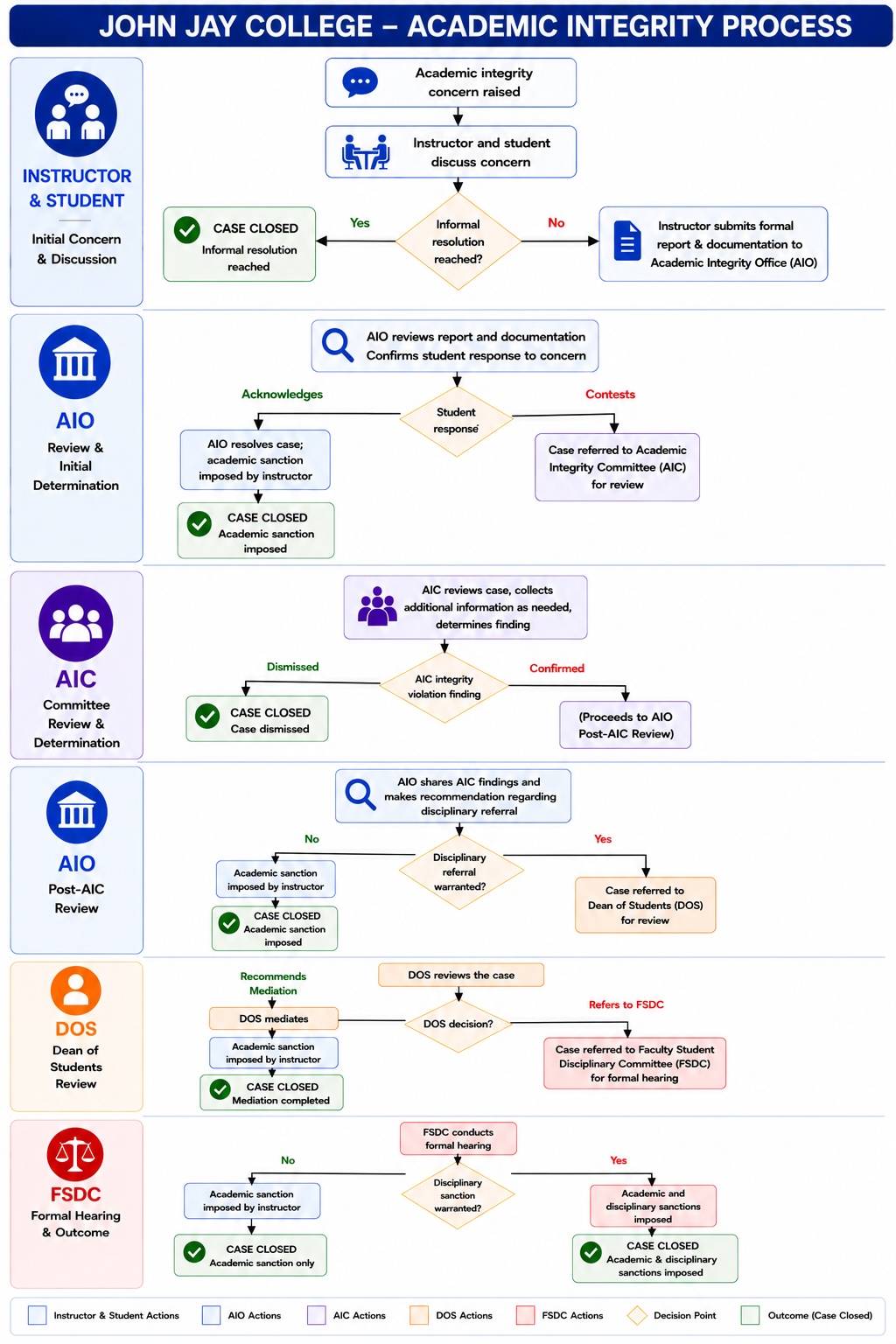
Text version of above flowchart:
Step 1: Initial Concern and Discussion
1. An academic integrity concern is raised.
2. The instructor and student discuss the concern.
Is an informal resolution reached?
• Yes → Case closed. Informal resolution reached.
• No → The instructor submits a formal report and supporting documentation to the Academic Integrity Office. Proceed to step 2.
Step 2: Academic Integrity Office Review
1. The Director of Academic Integrity, aka the Academic Integrity Officer (AIO), reviews the report and supporting documentation.
2. The AIO confirms the student's response to the concern.
If student acknowledges the concern and accepts academic sanction:
- The AIO resolves the case.
- The instructor's academic sanction is imposed.
Outcome: Case closed. Academic sanction imposed.
If student acknowledges concern, but rejects sanction:
- AIO resolves case
- Student can appeal academic sanction through Grade Appeal process.
Outcome: Case closed.
If student contests the concern:
1. The case is referred to the Academic Integrity Committee (AIC) for review. Proceed to Step 3.
Step 3: Academic Integrity Committee (AIC) Review
1. The AIC reviews the case.
2. The AIC collects additional information as needed.
3. The AIC reaches a determination.
Decision: AIC integrity violation finding
If no violation found then outcome = case closed and dismissed.
If violation confirmed, proceed to Step 4.
Step 4: Academic Integrity Office (AIO) Post-AIC Review
1. The AIO shares the AIC findings.
2. The AIO considers whether a disciplinary referral is warranted.
Decision: Is disciplinary referral warranted?
If no, the instructor's academic sanction is imposed.
Outcome: Case closed. Academic sanction imposed.
If yes, the case is referred to the Dean of Students (DOS). Proceed to Step 5.
Step 5: Dean of Students (DOS) Review
DOS reviews case.
DOS determination:
EITHER mediation recommended
1. The DOS conducts mediation.
2. The instructor's academic sanction is imposed.
Outcome: Case closed. Mediation completed.
OR referral to Faculty-Student Disciplinary Committee (FSDC)
1. The case is referred to the Faculty-Student Disciplinary Committee for a formal hearing.
Proceed to Step 6.
Step 6: Faculty-Student Disciplinary Committee (FSDC) Hearing
FSDC hearing held.
Decision: Is a disciplinary sanction warranted?
If no, the instructor's academic sanction is imposed.
Outcome: Case closed. Academic sanction only.
If yes, academic sanctions and disciplinary sanctions are imposed.
Outcome: Case closed. Academic and disciplinary sanctions imposed.
Summary of Possible Outcomes
• Case closed through informal resolution.
• Case closed with academic sanction imposed.
• Case dismissed after AIC review.
• Case closed after mediation.
• Case closed with academic sanction only.
• Case closed with academic and disciplinary sanctions imposed.
AI now stands for two different but related ideas: academic integrity and artificial intelligence. While artificial intelligence has become a major topic in higher education, academic integrity remains the broader framework that guides how we approach the ethical use of any source, tool, or technology.
Artificial intelligence and academic integrity are not inherently in conflict. AI tools can support learning, creativity, accessibility, and productivity when used thoughtfully and in accordance with course expectations. At the same time, they raise important questions about authorship, attribution, collaboration, and what it means to claim work as our own.
Because AI can be used in different ways across different disciplines and assignments, John Jay does not have a single College-wide policy governing all AI use. Instead, instructors establish expectations for their courses, which should be communicated through syllabi, assignment prompts, and classroom discussions. Students are responsible for understanding and following those expectations.
The Academic Integrity Office serves as a resource for students, faculty, departments, and administrators navigating these evolving questions. Through consultation, workshops, educational resources, and campus-wide conversations, we support clear expectations, responsible practices, and thoughtful engagement with emerging technologies.
Although technologies change, the core principles of academic integrity remain the same. Students are responsible for the work they submit and for accurately representing how that work was produced.
We are available to consult with students, faculty, departments, and other stakeholders on policies and procedures, concerns about specific situations, reporting questions, prevention-focused practices, assignment and syllabus design, and emerging issues such as generative AI. Contact the Director of Academic Integrity @ AcademicIntegrity@jjay.cuny.edu.
For Students
Simply put, academic integrity means completing your academic work honestly, acknowledging the contributions of others, and following course and College policies.
Every time you submit an assignment, take an exam, or contribute to a class discussion, you are representing that the work is your own and that you have honestly acknowledged the contributions of others. In doing so, you are not only earning a grade, you are building a reputation for honesty, responsibility, and intellectual integrity. The trust you establish with your instructors can shape opportunities long after a course ends, from letters of recommendation to mentorship, internships, graduate study, and employment. Likewise, the value of a transcript or degree depends on confidence that it accurately reflects a student's learning and accomplishments.
Academic integrity helps ensure that grades accurately reflect student learning, that all students are evaluated fairly, and that the degrees we earn retain their value. It also supports the development of skills that extend beyond the classroom, including critical thinking, research, communication, and ethical decision-making. This matters especially here at John Jay, where we center justice as our core value. As part of our commitment to fostering a community built on honesty, accountability, fairness, respect, and trust, we share a responsibility for academic integrity. We ask each member of our community to stand behind their work and contribute to a culture in which learning, achievement, and credentials have meaning. The goal of our academic integrity process is not only to address violations when they occur, but also to support learning, encourage good academic practices, and help students develop habits that will serve them throughout their academic, professional, and civic lives.
As new technologies, including generative AI (GenAI), become part of academic life, questions about authorship, attribution, and appropriate use continue to evolve. Academic integrity provides a framework for navigating these questions thoughtfully and responsibly while remaining accountable for the work you submit in your own name.
The best way to avoid any potential issue is to be transparent about your work. Keep notes on your sources, ask questions if you are unsure about citation requirements, and follow any guidance your instructor provides about using sources or outside assistance. Most of the time these policies are outlined in your syllabus, so look there first. If you’re not sure whether something is permitted, it is always better to ask before submitting your work.
Academic integrity violations include presenting someone else's work as your own, using unauthorized assistance or materials, collaborating when collaboration is not permitted, falsifying information or records, or gaining an unfair advantage over other students.
Examples include:
- Copying or sharing answers on assignments or exams
- Using unauthorized notes, websites, AI tools, devices, or other resources
- Submitting someone else's work, or having someone else complete work for you
- Reusing work from another course without permission
- Using ideas, words, images, or information without proper acknowledgment
- Fabricating or altering data, records, or documents
- Obtaining or distributing exam materials without authorization
- Interfering with another student's ability to complete academic work
Because academic work takes many forms, it is not possible to list every example. When you are unsure whether something is permitted, ask your instructor before proceeding.
Most concerns begin with a conversation between you and your instructor. If a formal report is filed, you will receive information about the allegation and any next steps in the review process from the integrity office.
If you have questions or concerns about an academic integrity issue raised by your instructor, your first step should be to communicate with the instructor and seek clarification. Academic integrity concerns can sometimes arise from misunderstandings about assignment expectations, citation practices, collaboration, or the use of academic tools and technologies. You may also contact the Academic Integrity Officer for guidance about the process, your options, and available resources.
Accidents do happen, but you can prevent them by carefully reading your syllabi and asking your instructors to clarify as needed. Some of the tools many of us use regularly may be prohibited in certain contexts, like Grammarly, which is an artificial intelligence-powered writing assistant. Even when a concern is unintentional, it may still need to be reviewed. The purpose of the review process is to understand what occurred and to determine whether a policy violation has taken place. If questions arise about your work, you will have an opportunity to explain your understanding of the assignment and how the work was completed.
A report initiates a review process; it is not a determination that a violation has occurred. If a report is filed, you will have an opportunity to respond and provide your perspective. The review process considers the available information and evidence before determining whether a violation has been established under College policy.
Consequences vary depending on the circumstances and may include
- academic sanctions imposed by the instructor (including grade penalties, such as failing the course)
- disciplinary sanctions imposed by the College in more serious cases
Transcript notations are disciplinary sanctions that may be considered in certain cases. Not every violation results in a transcript notation.
Yes, you should continue participating in the course while a case is being reviewed. A student cannot be barred from attending class solely because of an alleged or proven academic integrity violation.
If a report is filed and, after review, no academic integrity violation is found, the case will be dismissed and no academic or disciplinary sanctions will be imposed. A dismissed case does not result in a failing grade, disciplinary action, or transcript notation based on the alleged violation.
The Academic Integrity Office maintains records of reports and case outcomes as part of the College's official academic integrity process. A dismissed case is recorded as dismissed and is not treated as a confirmed violation.
Yes! Students are encouraged to seek guidance from appropriate College resources and may consult with advisors, support offices, or other individuals as permitted under College policy. The Academic Integrity Officer can also answer questions about the process and available resources.
For Faculty
A report must be filed when:
- The proposed academic sanction would result in a failing course grade.
- The student contests the allegation.
- The student does not respond to the allegation.
- A PEN grade is required because grades are due before the matter can be resolved.
Faculty are encouraged to report other violations as well, even when a matter has been resolved directly with the student. Reports help the College identify repeat violations, understand trends, and provide appropriate interventions and support.
Before filing a report, instructors should communicate directly with the student regarding the concern and retain documentation of that communication. The aim is to make sure students understand what the concern is and have a chance to explain themselves and their work. Dialogue can often lead to resolution. If you do end up filing a report, you'll need to submit into the record the correspondence you had with the student.
Use this form to file a formal report. Note that you’ll need to include all required documentation, including your syllabus, relevant assignments, coursework, and communications. Once a complete packet has been received by the Director of Academic Integrity at AcademicIntegrity@jjay.cuny.edu, we can start the process. If you have questions along the way, don’t hesitate to contact us.
You might select one or more of the following, depending on the nature of the conduct. See the policies linked above for more detailed explanations.
- Cheating: Unauthorized assistance, materials, devices, collaboration, or communication used during an assignment, exam, or other academic exercise.
- Plagiarism: Presenting another person's words, ideas, research, media, or creative work as one's own without appropriate attribution. This may include material copied from print or online sources, as well as the unacknowledged use of generative AI tools when such use is not permitted.
- Other:
- Obtaining an Unfair Advantage: Actions that provide an unauthorized academic benefit or interfere with another student's opportunity to complete academic work fairly, such as gaining access to exam materials or obstructing another student's work.
- Falsification of Records or Documents: Fabricating, altering, or misrepresenting academic information, data, records, signatures, or official College documents.
If you are unsure which category applies, select the category or categories that seem most relevant and describe the situation in the report. The Academic Integrity Office will review the information and can assist with classification if needed.
After receiving a complete report:
- The Academic Integrity Office reviews the report and supporting documentation.
- The student's record is checked for prior violations.
- The appropriate response is determined.
- Cases may be resolved through notification and acknowledgment or referred for formal review.
Informal Resolution
In some cases, a matter may be resolved without referral to the Academic Integrity Committee. The student receives formal notification of the report, the outcome, and any applicable academic sanction, and no further review is required.
Formal Review
When a case cannot be resolved through the initial review process, it may be referred to the Academic Integrity Committee for further review. The Committee reviews the available information, may request additional materials, and issues findings. The Academic Integrity Officer then communicates the outcome to the instructor and student.
Disciplinary Referral
In cases involving serious or repeated violations, the matter may be referred to the Dean of Students for possible disciplinary review.
Yes. A report may still be filed after withdrawal. In some cases, a PEN grade can be used to suspend the withdrawal until the review process is complete.
- What is a PEN grade?
A PEN, or pending, grade is a placeholder indicating that an academic integrity allegation is under review and a final course grade cannot yet be assigned. - When is a PEN grade used?
Typically when:- A student withdraws while a case is pending.
- Final grades are due before the review process is complete.
- How is a PEN grade requested?
Faculty should contact the Academic Integrity Officer and file a report. PEN grades cannot be assigned directly by instructors. - Is a PEN grade a sanction?
No. A PEN grade is administrative and temporary; it is not a disciplinary or academic penalty.
If an academic integrity case is still under review when final grades are due, PEN is the appropriate grade, though note, per the above FAQ, that it can only be imposed by the AIO and only if an Academic Integrity Violation Report has been filed.
Once the case is resolved, the PEN grade will be replaced. If a violation is confirmed, the instructor may assign the grade in line with the academic sanction they have chosen to impose. If the allegation is dismissed, the instructor will assign the grade that would otherwise have been earned in the course.
Yes. When submitting an Academic Integrity Violation Report, you may indicate that you believe the case warrants consideration of disciplinary sanctions in addition to any academic sanctions imposed in your course.
Disciplinary sanctions are separate from academic sanctions and may include measures such as academic probation, suspension, dismissal from the College, or, in rare cases, refusal to confer a degree.
The Academic Integrity Officer reviews all reported violations and determines whether a case meets the criteria established by CUNY's Academic Integrity Policy for consideration of disciplinary action. If so, the case may be referred to the Dean of Students for further review. The Dean of Students determines whether the matter can be resolved administratively or should be referred to the Faculty-Student Disciplinary Committee for formal proceedings.
While faculty recommendations are carefully considered, decisions regarding disciplinary sanctions and referrals are made through the College's academic integrity and student conduct processes.
Contact us:
Professor Helen Kapstein, JJC Director of Academic Integrity, AcademicIntegrity@jjay.cuny.edu