

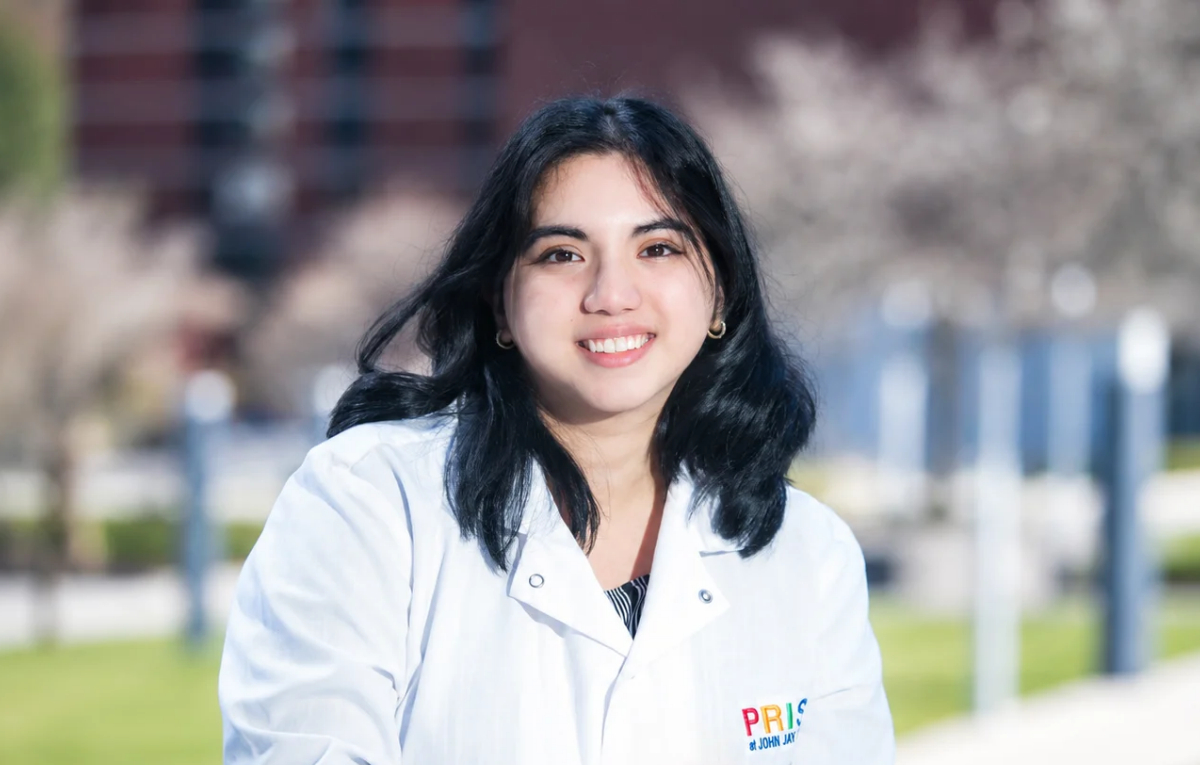
John Jay Research Puts Maisha Ahmed ’24 on Path to an MPH From NYU
Current Role: Digital Creation Lab (DCL) Program Assistant, Office of Academic Programs, John Jay; Graduate Research Assistant, ISEE Lab, New York University (NYU)
Graduate degree: Master of Public Health (2028), NYU School of Global Public Health
John Jay Degree: B.S. in Cell & Molecular Biology
Program: Honors Program, Program for Research Initiatives in Science & Math (PRISM)
Internships: Undergraduate Summer Research Intern, Jia Liu Lab, Advanced Science Research Neuroscience Initiative, CUNY; Undergraduate Summer Research Intern, Rogatsky Lab, Hospital for Special Surgery
Awards: Excelsior Scholarship; Office for Student Research & Creativity Support Fund
Mentors: Lissette Delgado-Cruzata, Ph.D.; Jason Rauceo, Ph.D.
Hometown: Ozone Park, NY
Career Aspiration: Public Health Advocate
What was life like before John Jay?
My parents moved to New York from Bangladesh and brought with them a deep love of community. My mom stayed home to take care of my younger brother and me. Dad worked in the hospitality and service industry, often holding down two jobs at once. Since he worked so much, he made sure to spend time with me when he could and would drive me to and from school. On those drives, much of my curiosity about the world was nurtured. Dad would play a game where he would have me observe what I saw during the drive, ask questions about it, and then try to solve a problem. I would say, “I don’t understand why there are so many cars parked on the street.” He would ask, “How would you fix that?” And I’d say, “They should all park in one parking lot to make it safer and create more walking space for pedestrians.” That game really got me thinking about the world and how to improve the public’s lived experience.
I was also a proud “PBS kid,” and grew up watching PBS Kids shows like Sid the Science Kid, WordGirl, and Cyberchase. Those shows helped me build empathy, consider different perspectives, and see education and learning as something positive. They instilled in me a desire to learn more about people’s experiences and how I could help improve their circumstances.
Why John Jay?
Living in Queens, I was aware of the power of a CUNY education—learning from industry professionals, graduating debt-free, and getting on a career path that would lead to social mobility. When I began looking at CUNY colleges, I spoke to family members to learn about their CUNY experience. My cousin, Marjia Uddin, whom I really admired, went to John Jay. She spoke passionately and positively about the College, the John Jay community, and the resources available to students.
Immediately, I started researching John Jay’s science programs, and what really attracted me to the College was how every subject was viewed through a justice-focused lens. At John Jay, you’re not just earning a degree as a steppingstone to your next career move. You’re gaining a deeper understanding of the world, and the many injustices people face. You’re acquiring skills that will help you solve community issues. For me, the idea of becoming not just a scientist but also an advocate felt special. Then when I visited the College and saw the community on campus, I was sold. I knew I belonged at John Jay.
What was the focus of your research at John Jay?
Dr. Delgado-Cruzata and Dr. Rauceo were amazing mentors who instilled in me a better mindset for research. They also got me thinking about public health as a possible career path. In Dr. Rauceo’s microbiology research lab, we studied Candida albicans, a yeast that naturally lives on and in the human body. When the yeast is off-balance, it can sometimes cause serious infections, especially in a hospital setting. I worked on the early stages of the research, helping identify proteins in the yeast to better understand how it behaves when it becomes invasive. The goal was to study how Candida albicans responds to different stimuli, which could help inform the development of future treatments.
I knew Dr. Delgado-Cruzata from my time in Femms (Female Empowerment through Mentoring Minorities in STEM program at John Jay) and asked her to be my mentor for my Honors capstone project. We looked at how the overturning of Roe v. Wade and new anti-abortion legislation in some states affected people outside of the “targeted” group of people getting abortions. One medication affected by these restrictions was Methotrexate, which is commonly used to treat conditions such as rheumatic and musculoskeletal diseases. Because the drug can also be used in abortion-related care, they were banned in certain states, so patients with autoimmune diseases faced barriers to getting the medication they needed. Through our research, we saw how policies intended to address one issue had unintended consequences for others. It made me think about what else might be overlooked when policies are created or implemented, and how those decisions can affect public health. This research inspired me to pursue public health as a career path.
How did your internships help shape your career goals?
At the Jia Liu Lab, Neuroscience Initiative, I looked at the effects of climate change on public health, specifically whether early-life exposure to pollution led to an increase in the development of anxiety, depression, or another mental health disorder. During the research, I examined the brain of a mouse model exposed to air pollution and analyzed its brain chemistry (or the extracted RNA expression) for signs of mental disorders. We learned there was an impact on brain chemistry from the pollution exposure.
My internship at the Hospital for Special Surgery was in the Rogatsky Lab. We investigated whether immortalized cells (cells grown in the lab) could serve as an affordable replacement for primary cells (cells taken from a person/tissue sample) to study how macrophages (the immune cells that fight infections) behave. The goal was to learn whether these immortalized cells could provide reliable results, and we learned that they could.
Ultimately, my biggest takeaway from all my research experiences both in these labs and at John Jay, was learning what I did and didn’t want to do in the future. I knew I didn’t want to go down the Ph.D. path. I loved the science, but sitting in a lab day in and day out wasn’t for me. I found the greatest joy in explaining the scientific findings to the public, helping them understand how this work could impact them, and, hopefully, improve their lives by adding programs in communities or driving policy changes.
How did your John Jay education help prepare you for your master’s program?
Being a John Jay alumna has given me a real advantage in the classroom at NYU. I’m not afraid to ask questions, share my perspective, or ask for clarity when I need it, and that alone has improved my educational experience. But there’s also a John Jay way of thinking—viewing things through a justice lens—that was instilled in me.
In the master’s program, class topics require viewing issues through an interdisciplinary lens, and that way of thinking feels natural to me because of my time at John Jay College. I’m able to see every side of the issue, including policy, structural injustices, health disparities, and the way different groups of people are disproportionately affected.
Where do you see yourself in 10 years?
I’ll be working in a nonprofit public health organization, hopefully in New York City, helping to advance public health policy. I’d love to work with researchers and policymakers to implement programs that can better serve communities, especially underserved ones. Ultimately, I want to be part of a team that helps promote positive change for the betterment of public health.


