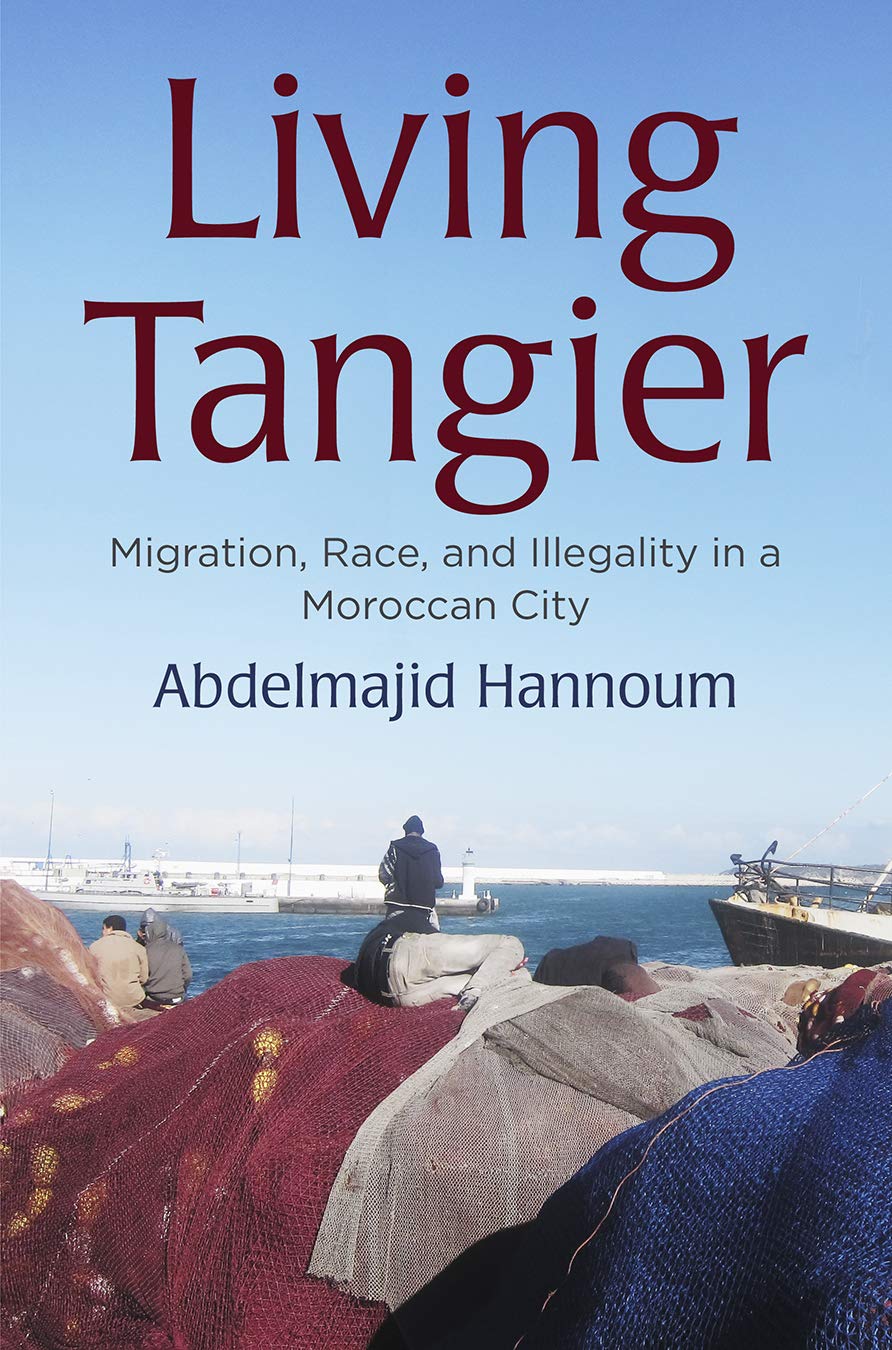
Living Tangier: Migration, Race and Illegality in a Moroccan City by Abdelmajid Hannoum is an ethnographic study of migration, race, and legality in the Moroccan city of Tangier, a historic crossroads between Africa and Europe. Based on long-term fieldwork, the book follows the everyday lives of West African migrants, young Moroccans, and European expatriates who inhabit the city in very different ways. Hannoum shows how Tangier is not merely a point of departure toward Europe, but a lived urban space where people work, wait, improvise, and negotiate their futures under conditions shaped by global inequality. Rather than treating “illegality” as a fixed legal status, the book examines how it is experienced, interpreted, and managed in daily life. Hannoum foregrounds the role of race, postcolonial history, and spatial practices in structuring social relations in the city, revealing how migration reshapes both migrants and the urban fabric they inhabit. Blending ethnography with critical theory, Living Tangier offers a nuanced account of mobility as a deeply social and political condition, rooted in the legacies of colonialism and contemporary border regimes.
Abdelmajid Hannoum is a Professor of Anthropology at the University of Kansas, where he teaches and conducts research on the intersection of history, culture, and politics, especially in North Africa, the Middle East, and France. He trained academically in Morocco, France, and the United States, earning advanced degrees, including a Ph.D. from Princeton University and earlier graduate work at Sorbonne University. His work bridges historical inquiry and ethnographic anthropology, with interests in migration, race, colonialism and postcoloniality, secularism, memory, and cities. Hannoum is the author of several influential books, including Living Tangier: Migration, Race, and Illegality in a Moroccan City (2020), The Invention of the Maghreb: Between Africa and the Middle East (2021), Violent Modernity: France in Algeria (2010), and Colonial Histories, Postcolonial Memories: The Legend of the Kahina (2001). He has also edited volumes such as Practicing Sufism: Sufi Politics and Performance in Africa (2016) and, more recently, Secular Narrations and Transdisciplinary Knowledge (2023). Hannoum’s career includes international fellowships and visiting positions at institutions such as the Institute for Advanced Study, Harvard, Columbia, and the Aga Khan Centre, and he has received honors including a Fulbright U.S. Scholar Award for advanced research.
Register
John Jay College educates fierce advocates for justice, a calling that demands robust debate, rigorous inquiry and respectful dissent. Consistent with this commitment, we support academic freedom and convene conversations reflecting multiple perspectives. The views expressed at events held at John Jay belong to the speaker(s) and do not represent the opinion of the college. See Legal and Ethical Guidance: Political Activities and Equal Access.