
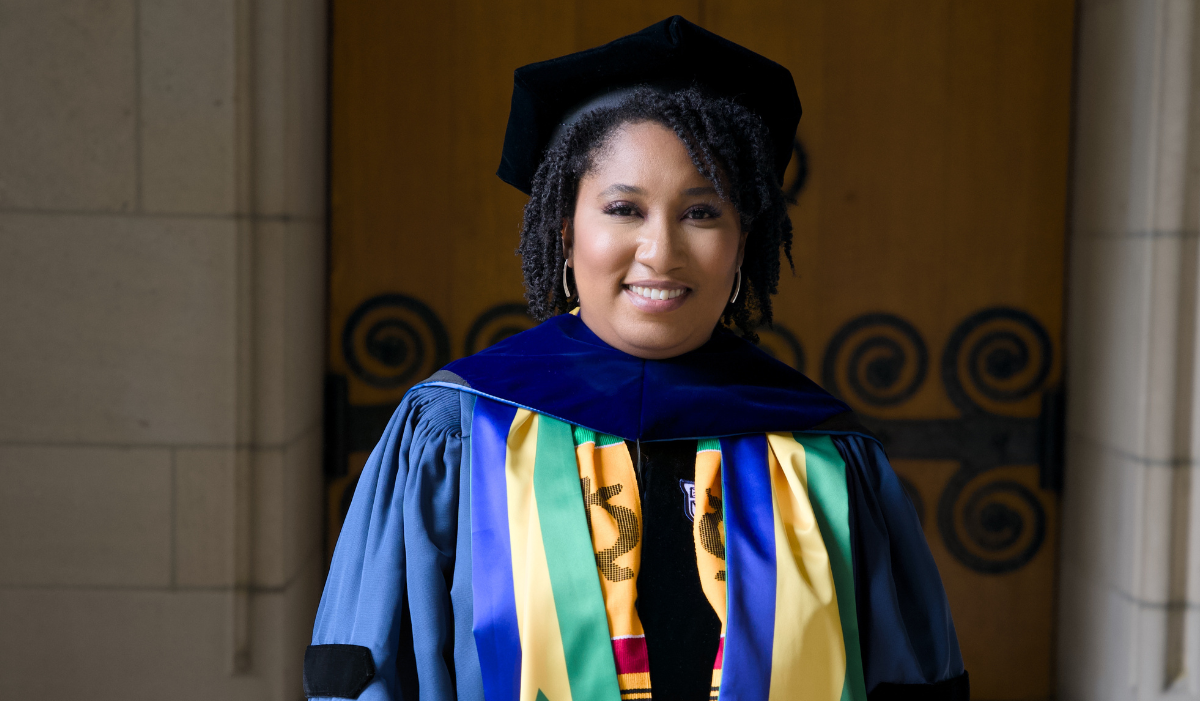
Crystal Kennedy ’16 Earns Ph.D. in Genetics & Genomics from Duke University
Major: B.Sc. Forensic Science
Graduate Degree: Ph.D. Genetics and Genomics from Duke University ’25
Programs: Honors Program, PrIMER (Program to Inspire and Mentor Undergraduates in Environmental Health Science Research)
Mentors: Litna McNickle, former Honors Program Administrative Director/Advisor; Lissette Delgado-Cruzata, Ph.D., Associate Professor of Molecular Biology; Daniel Yaverbaum, Ph.D. Physics Lecturer
Hometown: Saint Vincent and the Grenadines; Brooklyn, NY
Career Aspiration: Corporate Scientific Researcher/Project Manager
What was life like before John Jay?
Saint Vincent is a lovely place to grow up. The weather is great. There’s lush vegetation, rolling green hills, and the beaches, the beaches are beautiful. In school I always loved the sciences—physics, chemistry, biology, and math were my best subjects. I grew up with one younger brother and both of my parents. We were the type of family that would work hard at school or our jobs during the week, and then go to church on Sunday. For fun we’d play the piano or do dance performances at church. I always remember being very happy as a child.
Families in the Caribbean can be very competitive when it comes to their children’s education. Every parent wanted their kid to be the first in the class. Most of the time they’d push their kids to compete. My parents were never that way with me. I would place first, or in the top five, and they would just be proud and supportive. After school, I’d come home and my mother would say, “Okay, come sit, do the reading you need to do. Do you want something to eat?” That was it. Just supportive and making sure I was okay. Once when I was overwhelmed with writing up labs in high school and I was falling behind, my mom just gave me a hug and told me everything was going to be fine. She didn’t get mad at me or put pressure on me to achieve more. To this day, throughout all of my schooling, I think my family's calm, loving support helped get me through many academic challenges. When I was working on my Ph.D. and my mom and dad called me, their questions were always about me sleeping or eating enough. They knew I was smart and self-driven. So, they were more concerned about my well-being.
Why John Jay?
Every summer, as a family we’d come to New York City because of my dad’s job as a home health aide. One summer, I have no idea how she got it, but my mom found a flyer about John Jay. She knew I liked science and thought I might be interested in the forensic science program—which we found out was pretty well renowned. I got excited about the program and John Jay was the only college I applied to—which is crazy now that I think about it. I’m glad I got in.
How did your John Jay mentors put you on the path to success?
In many ways Litna McNickle showed me the same kind of support that my parents gave me growing up. One semester I was working 20 hours a week as a college assistant while also taking four science courses, one of which was my first genetics lecture. I was commuting from Brooklyn to Manhattan in the early morning and staying at school till late at night. It started to be really difficult to keep my grades up. That genetics course required reading complicated scientific journal articles, which was practically a new language for me.
Litna, my advisor in the Honors Program, listened to me and advocated for me when I told her I was struggling with the workload. She suggested that I drop the genetics lecture and pick it back up when I had more time to properly focus on it. After I dropped the genetics course, and my GPA went back up, Litna and I continued to talk. She always made me feel important and seen. She made sure I had a quiet space to study and got the resources that I needed. The next semester, when I took genetics again, I did really well in the class. I had an incredible genetics professor who was fantastic at breaking down information, answering questions, and being patient with students. Litna knew I could do the work, but she also knew that I was taking on too much. She gave me the guidance and support I needed to get back on track.
What was your experience like doing molecular research after John Jay?
Doing a post baccalaureate at Virginia Tech was a great step for me. I found out about it through Dr. Lissette Delgado-Cruzata, who oversaw the PrIMER program where I did undergraduate scientific research at Columbia University. Dr. Delgado-Cruzata created opportunities for John Jay students to go to conferences where we could present our work. During my senior year at one of these conferences, I learned about the postbaccalaureate research scholar program at Virginia Tech. It allowed me to get paid while gaining invaluable research experience with lots of hands-on mentoring and guidance for getting into graduate school. I spent a year studying genome sequencing, bioinformatics, molecular genetics, and even grant writing. It was a gap year with purpose where I could gain knowledge as a researcher.
What was your research focused on at Duke?
Most of my work, and my dissertation, was on Hutchinson-Gilford Progeria Syndrome, or Progeria for short. It’s an extremely rare genetic disorder that causes children to age rapidly. The average lifespan of a child with Progeria is 14 years old. Then they pass away due to atherosclerosis, or blockages in their blood vessels which leads to heart attacks and strokes. There’s a lot of research that looks at the blood vessel function in context of the disease, and Progeria is caused by one single mutation in a person’s genome. My work studied the lining of the blood vessels, looking at those cells that come in contact with blood flow and how they react, alter shape, and change the way they express genes. My hypothesis was that there was something wrong with the response in Progeria patients within the lining of their blood vessels that created a dysfunctional response to blood flow. My dissertation looked at gene expression and changes in those cells.
How did it feel to earn your Ph.D.?
It’s been a long, and sometimes arduous, journey. When I earned my Ph.D. there was this sense of relief that I’d never felt before. There was also a slight feeling of disbelief that I’d done it. Hearing someone call me Dr. Kennedy feels good, but strange. I’m the first person in my family to earn a Ph.D. I think earning my doctorate highlights a certain level of perseverance that I didn’t know I had—especially mental health wise. This is something I think a lot of Black students, minority students, and women need to know before going for your doctorate. Oftentimes the work is doable but the environment is where you experience the most pressure. Being the only person who looks like you can create a lot of mental barriers that can be tough to bring down. You have to take care of yourself while pushing through difficult work, so you can make it to the end of your program.
What’s next career wise?
I’d like to dive more into data analysis at a scientific corporation. There are so many different kinds of sequencing technologies and I’d love to expand my knowledge in that realm. I’d like to learn more coding languages and new ways of analyzing gene expression data.
Throughout my time at Duke, I’ve spent a lot of my summers mentoring undergraduate students. I’ve enjoyed that work and I’d like to find a way to continue doing it in the future. There are a lot of students who don’t understand that in STEM you can get your education fully funded. They don’t realize that earning their Ph.D. can change the trajectory of their lives and their family’s lives. I want to help open those doors for underrepresented students.
Please finish this sentence: Because of John Jay…
I learned how resilient I can be.