
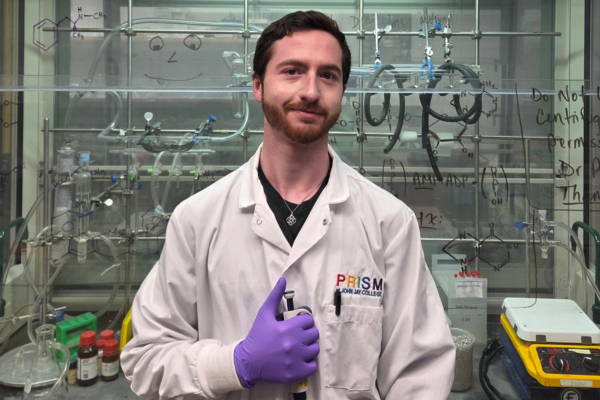
Andy Primrose ’26 Accepted to Five Chemistry Grad Programs
Major/Degree: B.S. in Forensic Science, concentration in toxicology and criminalistics
Programs/Clubs: Program for Research Initiatives in Science (PRISM), STEM Scholars Program, PRISM Peer Mentor, CUNY Justice Academy
Mentors: Gloria Proni, Ph.D. Forensic Science Associate Professor; Edgardo Sanabria-Valentín, Ph.D., PRISM Associate Director; Alejandra Myerston, STEM Retention Specialist
Hometown: Wappingers Falls, NY
Career-Aspiration: Scientific Researcher
Post-John Jay plans: M.S. in Chemistry, with a Concentration in Biochemistry, at San Francisco State University
What was life like before John Jay College?
I grew up in Wappingers Falls, New York, which is a town south of Poughkeepsie, NY. I have three brothers, two who are older and one who is younger. My father, who worked at a nuclear plant called Indian Point, got melanoma when I was 11 years old. At the time, there was a new kind of immunotherapy clinical trial that my mom was researching. She called his doctor and urged him to order it for my father. In my opinion, that drug gave my father three extra months of life—which was huge for us. At 57, my father passed away. I was only 12 years old. From what I understand, at Indian Point, they were pretty loose with hazard rules. Now, his entire team, except for one person, is dead.
I wouldn’t be the person that I am today had I not gone through that experience when I was really young. I’m not grateful that it happened, but I think it gave me a different perspective on life. It taught me a lot about empathy, compassion, independence, and resilience. In the future, if I can help create a drug that could improve someone’s life—or extend it even for a short period of time—I’d be proud.
After my father passed away, I was raised by a single mother. In Poughkeepsie, I got involved in theater where I did technical lighting—which was a passion of mine—and running because there’s a lot of open spaces to explore. I also enjoyed wilderness exercises as a Boy Scout. I’m actually an Eagle Scout now. I came out when I was 18 and now I’m a proud member of the LGBTQ community. Moving to New York City in 2025 for college really opened up my world. I found a more diverse community that felt very accepting of who I am as a person.
Why John Jay?
I actually applied to John Jay’s forensic science program three times—and I got rejected three times. When I was younger, I went through a lot back-to-back. First, my father died, then my last grandparent died, and then one of my aunts died. It was a really rough patch for a few years, and my grades were not up to par with John Jay’s standards. At around 19, I came out of that spiral. I decided that I couldn’t help my circumstances, but I always had a choice.
I knew that the forensic science program at John Jay—which is world-renowned—was perfect for me and I wouldn’t give up. I liked that it offered a lot of hands-on experience, not just in chemistry, but in analytical chemistry. Instead of just learning theories, John Jay students were actually applying them. I wanted that experience. So, I reached out to the school and they suggested that I go to a CUNY community college and then transfer directly into John Jay through the CUNY Justice Academy. That’s why I attended the Borough of Manhattan Community College (BMCC); it was the only way I could attend my dream school. I ended up completing my associate degree at BMCC in one year—that’s including general chemistry, organic chemistry, physics, and biology. It was all so I could seamlessly transfer into John Jay’s forensic science program through the CUNY Justice Academy. CJA even paid for my summer courses in 2024 so that I could transfer in the fall of 2025. I really overcame a lot of obstacles to get here.
What sparked your passion for science?
Science was always my favorite subject in elementary school and my aunt is a nurse; I think her work made me curious about science. When I was 10 years old, I asked my doctor, “Do you have my blood type on file?” They did not since I hadn't had surgery. So, I bought a little blood type kit at the drugstore. I pricked my finger, and there were four different spots for antigens that respond to your blood type depending on what it is. I thought it was pretty cool. Then my aunt taught me about the genetics behind it. Afterward, I was like, you know what, I’m going to make my whole family tree with blood types.
I saved up my allowance for months to buy two dozen of those little at-home blood test kits. During Thanksgiving, I forced my entire extended family to prick their fingers and mark the cards so that I could chart out the genetics of our blood type inheritance. Everyone was having a good time, then during dessert, I sat down at the counter and explained how I was going to test them all.
The results were fascinating to me because I could trace the inheritance. I found out that I’m the only person with type O blood in my family, which made me worry about getting an organ transplant if I ever needed it. It was nice that my family humored me, because outside of my aunt, no one was interested in science. I’m grateful that both my mom and my aunt nurtured my passion for science.
How did your mentors positively impact your educational journey and goals?
I wouldn’t be the researcher I am today if it wasn’t for Dr. Proni. Usually, when you’re an undergraduate student, you reach out to professors and ask if you can work in their lab. I was doing a tour for the CUNY Justice Academy Open House and I was walking around her lab explaining what each of the instruments do and she came up to me afterward. She said, “Oh, you’re Andy. I’ve heard about you. Why don’t you come work in my lab?” And that was it. She had never met me before but she took a chance on me. Luckily, she recognized my capabilities and I started doing research with her in January of 2025.
For the first three months, it was very structured—we’d come in at a certain time and we’d do research together. But then she had to go to Italy for a family emergency. So, from March till the end of the summer, she trusted me to do a lot of the procedures. Italy is six hours ahead, but I don’t really sleep well, so I would wake up at 3:00 in the morning and text Dr. Proni, “Are you awake? Can I call you with some questions?” Then we’d chat and she’d help me out with my research. It meant a lot to me that she had that level of trust in me. It helped me grow as a scientist and a researcher.
Dr. Proni also worked hard to get me into undergraduate research programs so that I would be paid to do research. She fought tooth and nail to get me funding to go to Atlanta for the American Chemical Society Spring 2026 Conference, which was truly a transformative experience. She’s always sending me opportunities. Her support has been fundamental to my academic journey.
Being a transfer student from the CUNY Justice Academy, Alejandra was a big part of my adjustment to John Jay. She set me up with a peer mentor and made sure I had extra tutoring. John Jay has the newest labs in the CUNY system, and honestly, at first glance, they can be intimidating. When I got to my first quantitative analysis class, everyone else was pre-lab ready, while I had never done anything like that before. Alejandra and PRISM helped me identify the gap between what everyone else already knew and what I didn’t.
What was your experience like as a PRISM Peer Mentor?
At first, I was a little skeptical about being a peer mentor. I liked the idea of helping people, but I didn’t know what happened behind the scenes in the program. Then Alejandra told me that I’d get a stipend for being a mentor. How could I say no to that?
One day, Alejandra texted our PRISM Peer Mentor group chat asking if anyone spoke Spanish. She needed to find a mentor who could help a student who could speak English but was more comfortable in Spanish. No one answered back that they could do it. At the time, Alejandra didn’t know that I was fluent in Spanish. I studied Spanish for two years in middle school and all four years of high school. There were a lot of native Spanish speakers in my classes, so I was playing catch-up with full immersion. I also worked at Target for a few years with the night crew—all of whom preferred to speak Spanish. So, when I responded to Alejandra’s text in perfect Spanish, she was flabbergasted. Spanish was Alejandra’s first language. She said, “I’ve known you for two years. Why didn’t you tell me? Sometimes I get tired of speaking English and we could have spoken in Spanish.”
Being a PRISM Peer mentor has been a really enriching experience. Alejandra sends me a lot of transfer students. I see myself in them and I want to give them the same level of support that I received when I was in their shoes.
What was the focus of your research with Dr. Gloria Proni?
It focuses on DNA, but it’s more of a chemistry project. DNA forms a ladder, or a twisted spiral staircase, called a double helix. In nature and in our bodies, the helix is always shaped right-handed because the rungs of the ladder are all shaped right-handed. In this research, we’re looking at artificial nuclear units of the DNA and inserting them into the sequence. We put some of the units right-handed, like normal, to see what the helix looks like, then we change a few of them to be left-handed to see how far we can push it before the helix flips and becomes an unnatural left-handed version. It’s a lot of organic polymer work and very chemistry based. It has applications that are pretty far off in the future. The mRNA vaccine for Covid uses the same base units that we’re using, but they break down very quickly in the body because we have enzymes specifically for the right-handed, natural versions. Our research is just exploratory, but if we could invent something that used left-handed units, that your body doesn’t recognize, it could be a game-changer with big medical applications.
What are your plans after graduation?
I applied to nine graduate school programs—four were Ph.D. programs, and five were master’s degree programs. I picked four schools on the West Coast, because I visited San Francisco and I loved it there. I also picked four schools in New York and one in Amsterdam. I was accepted into one of the Ph.D. programs—CUNY Graduate Center for a Ph.D. in biochemistry—and four of the master’s degree programs. I’m excited to say that I'll be moving to San Francisco on July 1st and attending San Francisco State University to earn my M.S. in Chemistry with a Concentration in Biochemistry.
If you had asked me a year and a half ago, if I was considering grad school, I would have quickly responded, “Absolutely not.” But because of my mentors, I was encouraged to apply. I’m really grateful for their endless support. They’ve set me up in a position to earn a graduate degree, which would allow me to work in a lot of fields that I wouldn’t otherwise be qualified to do. Grad school applications are something no one in my family has ever done, but my mentors really helped me understand the process. It’s a very daunting process, but they made it easier for me—Dr. Proni even wrote my letter of recommendation.
Where do you see yourself in 10 years?
I see myself in a lab. It’s definitely going to be something involving chemistry—hopefully drug chemistry or medical chemistry. I would love to work on developing medications and treatments.
Please finish this sentence: Because of John Jay…
I have the opportunities and experience I need to succeed as a scientist.