
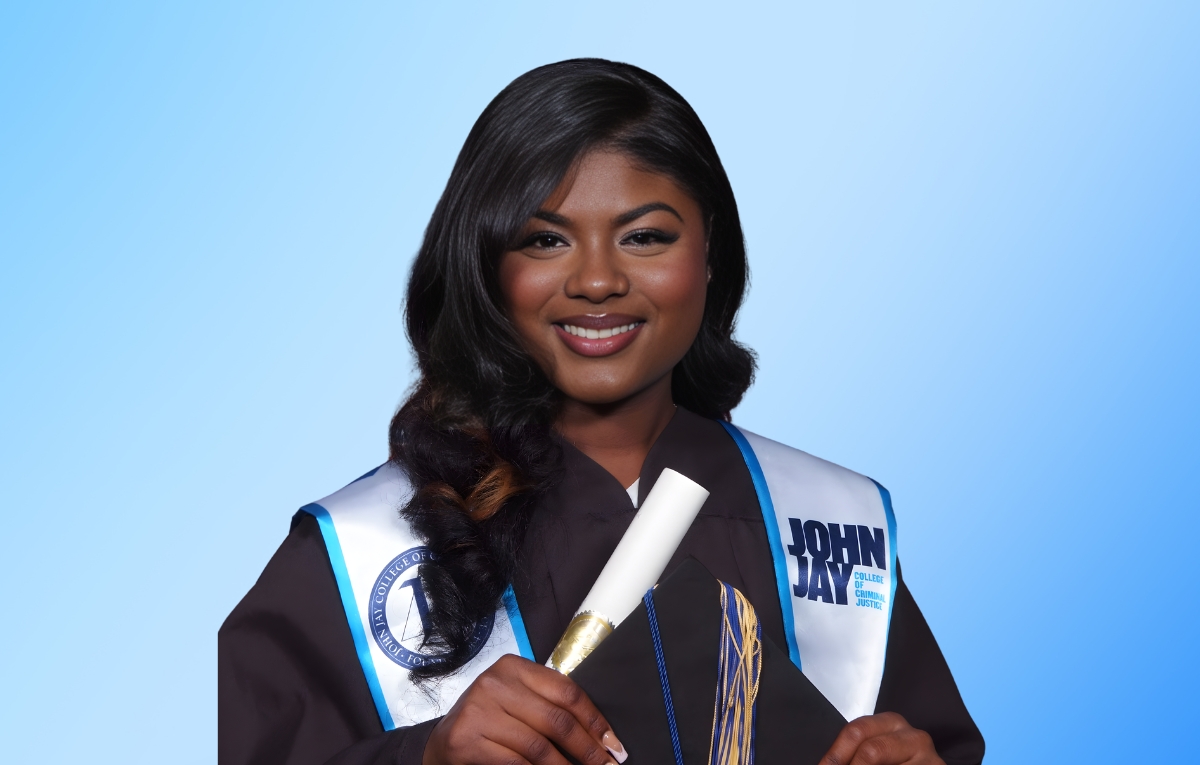
In-Deria Barrows ’26 Wins Scholarship to Earn PharmD
Major/Degree: B.S. in Cell & Molecular Biology
Minor: Psychology
Programs/Clubs: PRISM; PRISM Undergraduate Research Program; John Jay Student Council, Treasurer
Mentors: Ajejandra Myerston, STEM Retention Specialist, PRISM; Nathan Lents, Ph.D., Professor of Biology; Edgardo Sanabria-Valentín, Ph.D., Associate Program Director, PRISM
Internships: Harlem Biospace, Operational Intern; Johnson & Johnson, KENVUE CAMP/Bottomline Intern; Museum of Natural History, Museum Educational Experience Program (MEEP) Intern
Hometown: Brooklyn, NY; Portland Parish, Jamaica
Career Aspiration: Medicinal Researcher
Post-Graduate Plans: Earn a Doctor of Pharmacy at Albany College of Pharmacy and Health Sciences (ACPHS)
What was life like before John Jay?
I was born in Florida but raised in Jamaica by my aunts. My mother was part of a work travel program, and, for my stability, my aunts told her to let me live with them. I lived on the island and went to school there for most of my youth, but I spent summers in the States. When I was 16, I graduated from high school in Jamaica and moved to Brooklyn, New York, to live with another aunt of mine. When I got to New York City, I felt I needed to learn about the education system before going off to college, especially because education is very different in Jamaica. I was enrolled in high school, did my senior year, and graduated valedictorian. School has always been my happy place. I’ve always done very well academically.
When I started going to school in New York, it was a bit of a culture shock because the workload is much lighter here. So, in many ways, I felt overprepared. I was also surprised by how freely students moved through the classrooms and spoke with the teachers, sometimes even calling them by their first name. In Jamaica, you must raise your hand and call the teachers by their title and last names. And even the way students interact and communicate with one another is so different and fast-paced.
I was excited to start my college journey, but just as it began, my life took a major hit. In the fall of my freshman year at John Jay, about a week before my 18th birthday, the apartment above ours had a fire that spread. Firefighters put the fire out, but there was so much damage from the flames and the water used to extinguish them. The ceiling crashed down and our entire apartment was flooded. Everything, from our clothes and furniture to the appliances and technology, was damaged or destroyed.
How did you get through this challenging situation?
The Red Cross put us in temporary housing for a few days. At the time, my aunt and I had about $600 between the two of us. I was also new at John Jay, so I didn’t know about all the emergency resources and support available to me at the College.
My aunt and I had to set aside our feelings, shock, and sadness to figure out our living situation. We went from shelter to shelter and eventually we were told that our apartment walls had been replaced, so we were allowed to go back to our apartment. We still didn’t have electricity for a few weeks, so I would stuff my backpack with all our rechargeable devices and charge them at John Jay. I would stay as late as I could on campus and make sure to do all my assignments while at John Jay because we didn’t have Wi-Fi at home.
Since our electricity wasn’t on, we couldn’t keep our food refrigerated and heat it up in a microwave. My sister, who was a flight attendant, always brought us warm meals whenever she was in town. She would keep the food warm in an insulated bag. At the time, I was also working with a nonprofit called Bottom Line. They learned about what happened and gave me a gift card so I could buy whatever my aunt and I needed. It took us some time to rebuild, but I was grateful to have people who cared for us and helped as much as they could. I was extremely thankful to have John Jay College as a safe refuge and to finally have a roof over our heads again.
Why John Jay?
Ever since I was a little girl, I knew I wanted to go to college and work in the field of medicine. I wanted to be a doctor, though I wasn’t sure what type. I knew I wanted to help people through therapies. I also knew that to go to medical school here in the States, you have to have a bachelor’s degree. When I was doing my college search, I looked for an institution that would let me explore science fields through hands-on research and practice. John Jay stood out to me, and to my surprise, was the first school to accept me.
I remember when I got the acceptance letter, I was crying, because as a first-gen student I didn’t know if going to college was possible for me. Both my parents and I didn’t know how the application process worked or if I would be able to afford tuition. But once I got the news that I was officially a John Jay student, I knew I would find a way forward. I remember calling John Jay’s admissions team and asking for guidance on securing financial aid because both of my parents were from and living in another country. The team was super helpful, pointing me in the right direction and guiding me throughout the process. To become a doctor, John Jay was where I needed to be.
What sparked your passion for pharmaceutical sciences?
When I was little, I was a big fan of Doc McStuffins. If you look at photos of me as a kid, I was wearing a white lab coat, holding a stethoscope in one hand and a plush toy in the other. At the time, I wanted to be a veterinarian, and that quickly evolved as I grew older. I was frequently in doctors’ offices for a hearing impediment I was born with. I also had a horrible eczema flare-up where my skin couldn’t come into contact with anything. I remember the wonderful interactions I had with the doctor who treated me. I was allowed to ask questions to learn what was happening to me. The doctor looked at me, smiled, and said, “You have the personality of a doctor. You’re asking all the right questions.” I took comfort in her presence and in her words. Ever since then, I knew I wanted to be a doctor.
Then, during my sophomore year at John Jay College, I interned with Johnson & Johnson. I was able to visit their labs and learn about the skincare lines they were producing. At the time, they were working on an Aveeno skincare line to help people with eczema. I did a case study to see how the skincare line works compared to the prescribed therapies. The thought, science, research, and care that go into making these products is what really got to me and blew me away. I felt inspired. I realized I wanted to be able to help people by providing them with affordable drug therapies that would make them feel better.
How did your time with the Student Council enrich your experience?
Before joining Student Council, I didn’t know where to go for help or assistance, and early on in my college experience, I didn’t have a network of support. After joining Student Council, I found a real sense of community, gained a deeper understanding of John Jay and all its offerings, and found purpose. My mission was to help all John Jay students.
Given my personal experience with my apartment fire freshman year, I wanted to make sure I had all the resources available and ready for students facing housing insecurity, food insecurity, or who needed emergency assistance in some way. I wanted to be a resource for my peers and help them overcome whatever challenges they were facing. I wanted to make sure they had all the tools they needed to succeed academically—whether that meant connecting students with faculty or staff, ensuring the math tutoring center had enough calculators, or making sure the science labs had sufficient goggles and gloves. I wanted to help and it felt good to help.
How did your PRISM mentors help put you on the path to success?
Being in PRISM, you’re given so many opportunities for growth. That includes applying for various internships, joining incredible research labs, attending important conferences, and connecting with a network of people in your chosen career field. Beyond that, the faculty and staff in PRISM really step up for students.
Alejandra Myerston always made sure I was on top of things, taking the right courses, encouraging me when I wasn’t feeling great about a class, and reminding me of my potential. She also made sure I was taking breaks when needed. If I expressed interest in something, she made sure she pushed me toward opportunities in that area. She always saw what I was capable of and encouraged me to do things I didn’t think I could, like conducting research through the Undergraduate Research Program (URP).
Dr. Ed (Edgardo Sanabria-Valentín) was a pillar for me, especially when it came to applying to graduate school. Over the summer, he encouraged me to prepare applications, but I wasn’t sure what I wanted to do after my time at John Jay. He suggested I prep for the MCAT so I could get into med school, but when I told him my heart wasn’t in it, he really listened. He said, “In-Deria, let’s figure this out together.” And that’s what we did. I realized I wanted to work in women’s health, finding cures and developing therapies that would help women. Dr. Ed said, “Give me a day or two to find the right programs and network for you.” Sure enough, he did. He connected me with several alumni in the alumni mentoring program who were working in medicine, one as a pharmacist and one as a physician assistant. He sent me resources and asked, “Have you considered pharmacy school?” I hadn’t, but once I met Dr. Khamattie Shivanie Uzagir ’17, a pharmacist, everything clicked for me.
Khamattie invited me to her pharmacy, let me shadow her, and see what life as a pharmacist was like. It felt like the perfect fit for me. Soon after, Dr. Ed pushed me to apply to pharmacy school. He helped me find the programs, let me know when the materials were due, and even texted me over holiday break to make sure I was working on my essay and forms. All my fees were waived thanks to PRISM. My applications and essays were submitted one week before the deadline. I applied to six programs and got into every single one.
What was the focus of your research with Dr. Nathan Lents ?
Dr. Lents took a chance on me and let me join his lab when I didn’t know what I was doing. He made sure I knew I belonged in his lab, no matter how out of place I felt. He never turned me away, always answered my questions to the best of his ability, and explained things to me.
The very first research project I did with him was commissioned by the Museum of Modern Art. They had a few art pieces featuring animal fur and wanted to learn what type of animals they were. They cut off pieces of hair (or pelts) from the artwork and sent them to us. First, we had to find the most effective way to extract DNA from these samples without damaging them. Then we had to identify the sequencing (primer sets) we would use to compare our DNA samples to. Once those two pieces were in place, we could extract the DNA, compare it to the sequencing, and see how closely related they were to the species we have today.
The second research project focused on plant DNA and creating a sort of fingerprint database to help identify the different plants and flowers. Like our animal DNA project, we had to identify which genes in the plants would provide the DNA information we needed for identification. Once we found the plant genes, we had to figure out how to properly extract the DNA. Then we had to identify the right sequencing to compare our samples against. Working with plants was very different because some of the DNA sequencing didn’t exist, so we had to produce these primer sets ourselves.
Our research was twofold. Not only had we been working on creating this database, but we had also been exploring how a plant identification tool could help solve crimes. In our study, we focused on baby’s breath because it’s the least-researched yet the most commonly found flower at crime scenes. If a petal had been found at a crime scene where a woman had been murdered, using our database, the flower could be linked to a local flower shop, the purchase traced to the person who bought the flowers, and that could have led investigators to a possible suspect.
Why did you select Albany College of Pharmacy and Health Sciences?
I wanted to go to a grad school where the atmosphere felt right, student support was in place, and opportunities for in-the-field experiences were plentiful. I also wanted to go to a place I could afford, and thankfully, Albany College of Pharmacy and Health Sciences awarded me $20,000 per year for the duration of the program—offsetting a significant portion of the financial burden. When I toured Albany College of Pharmacy and Health Sciences, it reminded me a lot of John Jay—a welcoming, beautiful campus, well-equipped labs, small cohort sizes so everyone knows everyone, and attentive advisors and mentors who care. But what really stood out most to me was the rotations students get to do every summer. The idea of having these on-the-ground, hands-on pharmaceutical training experiences throughout my time in pharmacy school was exciting.
Where do you see yourself in 10 years?
I’ll be Dr. Barrows, working in the pharmaceutical industry at a company like Eli Lilly, creating medications and therapies that improve women’s health and their lives. I also hope to work in a hospital pharmacy at some point in my career, helping patients access the treatments they need.
Finish this sentence: Because of John Jay…
Because of John Jay, I’m on the path to becoming a doctor and making my dreams come true.