
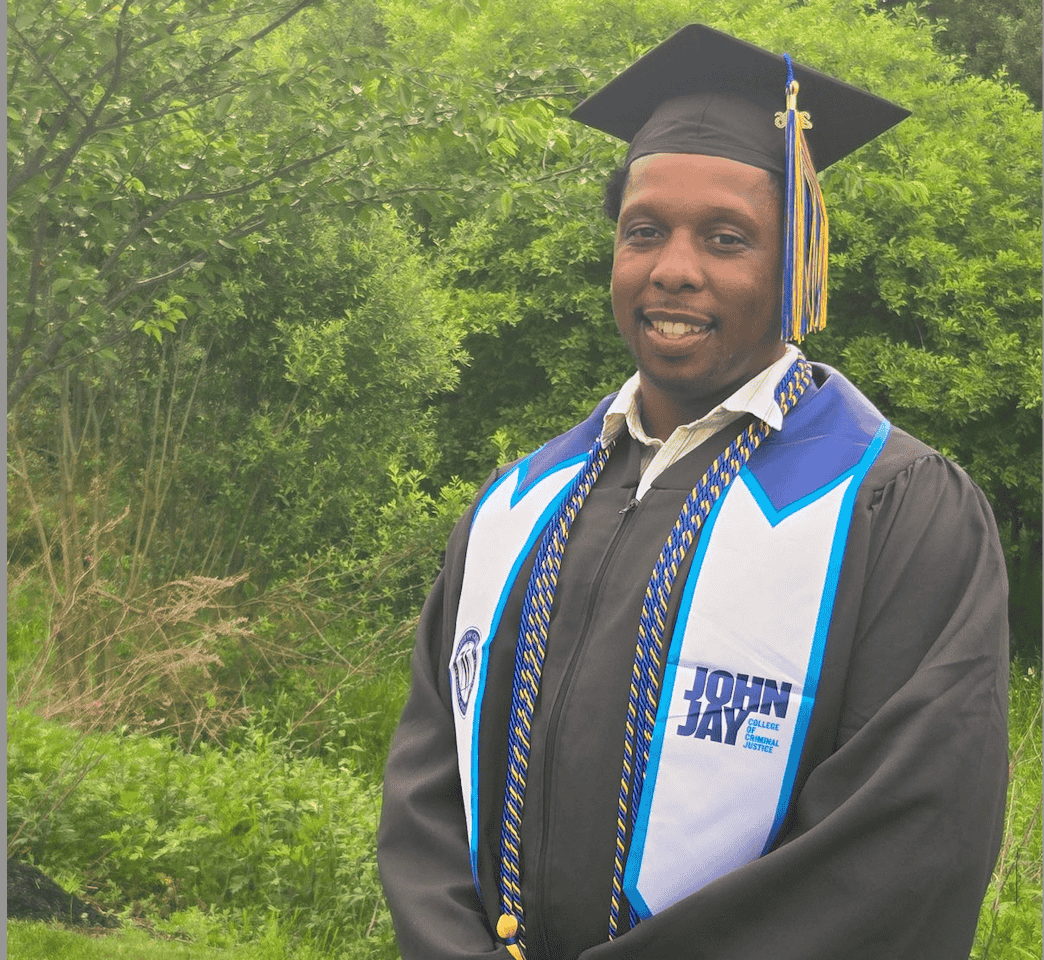
Karreim Richardson ‘26: From Radical Doubt to a Bachelor’s Degree
Majors: Economics & Philosophy
Program: Prison to College Pathways at the Institute for Justice & Opportunity
Hometown: Brooklyn, NY
Post-grad plans: Job with Incarceration Nations Network
What motivated you to enroll in the Prison to College Pathways (P2CP) program?
My pursuit of higher education motivated me, but I think an even more important question is what motivated me to stay. Denisse Martinez and Dr. Carla Barrett were genuinely invested in my journey. They took the time to understand my goals, interests and aspirations and they helped connect me with opportunities that aligned with them. Their support made me feel seen as more than just a student.
Looking back, enrolling in the program was important, but staying engaged and committed was even more important. The relationships, guidance and support I received through P2CP were the major reasons I continued pushing forward.
My story is not just about an individual accomplishment. It is also about the support systems that made that accomplishment possible. Organizations such as P2CP, Educational Release, the Institute for Justice and Opportunity, John Jay and the many faculty, staff and support systems connected to them should be celebrated. Their work demonstrates what can happen when institutions invest in people and provide meaningful opportunities for growth.
What drew you to pursuing a double major in economics and philosophy?
I realized that economics and philosophy answered different parts of the same questions. During one semester, I was taking both subjects at the same time and I began to see how naturally they connected. Philosophy helped me think about what society ought to be while economics helped me understand how society actually operates. Together, they gave me a broader perspective on people, institutions and the problems we face. Once I saw that connection, pursuing both majors felt like the natural choice.
Philosophy challenged me in ways I had never been challenged before. The more I studied philosophy, the more I realized it was less about finding answers and more about learning how to think. It strengthened my critical thinking skills, made me more analytical and helped me better understand myself and others. It also helped me navigate difficult periods in my life by teaching me how to reflect, reason and examine my assumptions.
Economics gave me practical tools to understand how people, organizations and societies make decisions. It taught me how to gather information, analyze data, identify patterns and think about incentives. Together, they taught me that good answers begin with good questions and gave me the ability to think deeply and analyze practically.
Tell us about your first day of class at John Jay.
It felt surreal. I remember being focused on the bigger picture: earning my degree and creating a better future for myself. There was a sense of responsibility because I knew there were people depending on me to succeed. At the same time, I was nervous because I was entering a new environment and wasn’t entirely sure what to expect.
I remember introducing myself and sharing some of my background, including my martial arts experience, and discussing Immanuel Kant. That first class set the tone for my experience at John Jay: challenging, thought-provoking and full of opportunities to see familiar ideas in new ways.
That day was especially meaningful because I was pursuing my degree while participating in the Educational Release Program. The opportunity to attend classes on campus while navigating incarceration gave education an even deeper meaning for me. It reinforced my belief in the transformative power of learning and strengthened my determination to succeed despite the obstacles in front of me.
Was there a class, book or concept that has had a lasting impact on you?
René Descartes’s method of radical doubt and the statement, “I think, therefore I am” from Meditations has stayed with me. Not just the quote itself but also the process behind it. Descartes challenged readers to question everything and strip away assumptions until they found something that could not be doubted. That idea resonated with me because my own experiences forced me to question many assumptions about myself, society, institutions and what was possible.
His method taught me the importance of getting to the foundation of a belief before building on it. If something can withstand scrutiny, then it can serve as a foundation for something greater. That lesson continues to influence how I approach problems, ideas and decisions today.
Did any John Jay faculty members, P2CP staff or others serve as a mentor to you?
I wouldn’t point to one specific mentor as much as I would point to a collective support system. Professors James DiGiovanna, Stephanie Attar and Genevieve LaForge all played important roles in my development. What I appreciated most was that they rarely told me what to think. Instead, they asked questions that challenged me to think more deeply and arrive at my own conclusions. They trusted me to do the work of learning for myself while remaining available to offer guidance when needed. Looking back, I would describe them less as mentors and more as guides. They helped me navigate my journey while allowing me to discover my own path.
What helped you stay motivated throughout the program?
What helped me stay motivated was a combination of support, community and purpose. My professors kept me motivated by being present. They challenged me intellectually and created an environment where I felt encouraged to learn and grow.
My classmates also played a major role because I was part of a cohort that supported one another. They encouraged me to ask questions, engage with difficult ideas and continue learning. Some of the most valuable conversations were not the ones where we found answers, but the ones that inspired better questions.
My deepest motivations were my family and my desire to prove what was possible. I wanted to succeed for the people who believed in me and supported me. At the same time, I wanted to demonstrate that education can transform lives and that circumstances do not have to define a person’s future. I knew there were people, including individuals who were still incarcerated, who could look at my journey and see new possibilities for themselves. That responsibility kept me moving forward, even during difficult moments.
What do your friends and family members think or feel about your accomplishment of earning your degree?
I think what resonates most with my family is not that I earned a degree, but how I earned it. People can arrive at the same destination through very different paths. The degree is the achievement, but the journey is the story.
Finish this sentence: earning my degree makes me think ________.
“Wait…is this actually real? Did I really do this? Is somebody playing a joke on me?” After everything it took to get here, there are times when it’s still hard to believe I actually reached this milestone.
Finish this sentence: earning my degree makes me feel ________.
Earning my degree makes me feel proud, but not because of the degree itself. The degree does not validate me. The degree is a result, not a source, of validation. The diploma is a symbol of the journey, but the real source of my pride comes from the person I became while earning it and the community that helped me get there.
If there is one lesson I would leave behind, it is that success is rarely the result of one person acting alone. Behind every achievement is a community of people, programs, and institutions that help make it possible. My degree may have my name on it, but it represents the efforts of many people who believe in education, opportunity and second chances.