
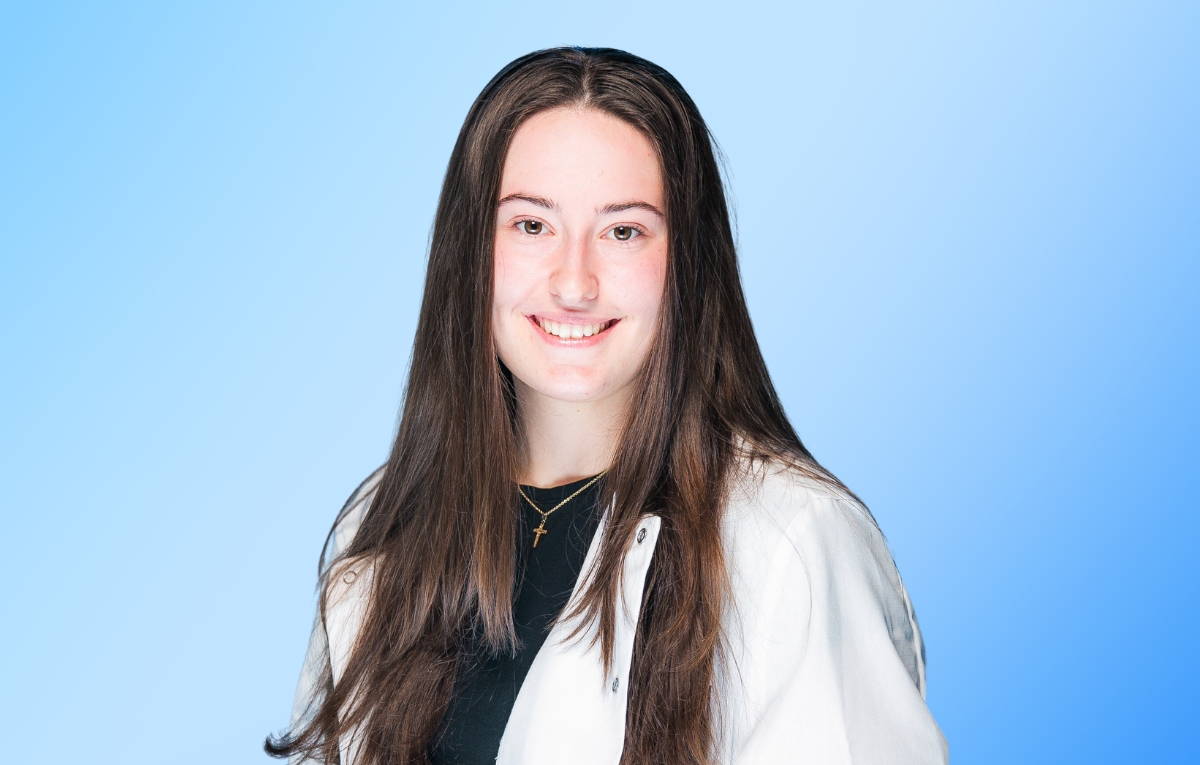
Brooke Fontaine ’26 Earns Full Scholarship to Pharmacology PhD Program
Degrees: B.S./M.S. in Forensic Science with a concentration in toxicology and criminalistics
Programs: Forensic Science Dual Degree Program; Honors Program; PRISM; PRISM Undergraduate Research Program; Women’s Soccer Team
Mentors: Marta Concheiro-Guisan, Ph.D., Assistant Professor of Toxicology; Edgardo Sanabria-Valentín, Ph.D., Associate Program Director, PRISM; Peter Diaczuk, Ph.D., Professor; Adrienne FitzGerald, Student Support Manager, Honors Program
Internship: University of Pennsylvania, Summer Undergraduate Internship
Current Role: Adjunct Lecturer, General Chemistry Recitation, John Jay College
Hometown: Essex, VT; Manhattan, NY
Career Aspiration: Professor and Scientific Researcher
What was life like before John Jay?
I grew up in Georgia, Vermont, a quiet, small town about 20 minutes from the Canadian border. I loved growing up there. It’s in the middle of nowhere, surrounded by nature, and absolutely beautiful. My hometown is so different from New York City. We didn’t have 24-hour corner bodegas or big shopping centers. We only have small family-owned businesses. There’s no public transportation, so we had to drive everywhere, since everything was several miles away. Our town didn’t even have a high school. I had to go to another town, about 30 minutes away, for high school.
When my parents found out I was accepted to John Jay and would be moving to New York City, they were so excited for me and incredibly proud. I’m the first in my family to graduate from college. They’ve always supported my dreams of going to college and becoming a scientist.
Why John Jay?
I fell in love with forensic science in the eighth grade. So when it came time to apply to colleges, I researched institutions across the country that offered forensic science as a major. I also needed the college to have a women’s soccer team, because I wanted to stay active in the sport and be supported by my teammates while earning my degree.
John Jay came up in my search as one of the top schools for forensic science with an excellent soccer program. After speaking with John Jay representatives, and seeing the campus and its offerings, coming to John Jay felt like the natural choice. Once I was enrolled and moved to the city, I lived in the College’s New Yorker dormitory during my freshman year, then I got an apartment with my soccer teammates for the rest of my time at John Jay.
Beyond the programs at the College, one of the things that drew me to John Jay was its location in the heart of New York City. I knew I would be surrounded by opportunity as a John Jay student. Whether I was applying to an internship, working in a research lab, or expanding my network at a John Jay event, there were opportunities waiting for me everywhere.
What sparked your passion for science?
I was fascinated by science from an early age. I loved looking into microscopes and learning how things worked. I was also drawn to the criminal justice field. I saw the TV show NCIS and realized the role of forensic scientist was a job that combined both science and criminal justice. Specifically, the character of Abby Sciuto, a forensic scientist on NCIS, stood out to me. She was the one who made me go, “That’s what I want to do!” It was cool to see how Abby could take evidence collected at a crime scene and analyze it in a science lab. Her character helped investigators connect the dots to solve crimes. Seeing all the tools she used to analyze evidence, whether it was looking at DNA, ballistics, or different fingerprints and then matching them to the offender, was so inspiring to me. What’s even cooler is that the actress who played Abby, Pauley Perrette, created a forensic science scholarship at the College.
How have your mentors enhanced your college experience?
All the mentors and professors who are part of the Honors and PRISM programs have offered a lot of guidance and contributed to my success as a student and my growth as a researcher. I came to John Jay with the belief that I would just go to class, earn my bachelor’s degree, graduate, and start working.
Meeting my Honors advisor, Ms. Fitz (Adrienne FitzGerald), changed that. She opened a new world of possibilities for me. Ms. Fitz was the first to suggest I try doing research while at John Jay, something I had never considered. She told me, “Give it a shot. If you don’t like it, you can try something else.” She also suggested I apply to PRISM, which put me on the path to becoming a scientific researcher.
In PRISM, Dr. Ed (Edgardo Sanabria-Valentín) connected me to various opportunities, including internships, networking events, and my first research opportunity with Dr. Diaczuk. Dr. Ed also encouraged me to pursue a master’s degree by introducing me to the forensic science dual-degree program at John Jay. After I was accepted into the program, I began to conduct research with Dr. Conchiero-Guisan. That’s where I discovered my passion for toxicology research.
I really credit Ms. Fitz and Dr. Ed with introducing me to the research world and the many opportunities it offers. I loved that they both pushed me to take a chance on different learning experiences and to make the most of each one.
What is the focus of your research at John Jay?
The research in Dr. Diaczuk’s lab was focused on ballistics, and I was part of the team conducting preliminary studies on less-lethal ammunition. This type of ammunition is used by law enforcement during protest situations and crowd control efforts. Specifically, we looked at bean bag ammunition—fabric pouches filled with lead pellets. At the time, there had been a lot of articles talking about how this type of ammunition, when used, had a negative long-term health impact on the people who were hit. The injuries were aggressive. During this preliminary work, we reviewed articles that focused on the variables that could affect the ammunition’s impact. Everything from the accuracy of the ammunition, the angle from which the ammunition was shot, to whether the distance or speed could have an effect.
In Dr. Concheiro-Guisan’s lab, we were analyzing hair samples to detect stress biomarkers. Your body produces cortisol, cortisone, and endocannabinoids, which are biomarkers associated with the stress response. We wanted to see how these biomarkers show up and change during a stressful period of time. We found that pregnancy is a particularly stressful time, so we collected samples from pregnant women. Specifically, we were interested in seeing if there was a correlation between stress level throughout the pregnancy and the changes in the biomarkers. We developed a validated method to analyze the samples. So far, the data is showing an upward trend in cortisol and cortisone across the trimesters, but nothing conclusive yet in terms of the endocannabinoids.
How did these experiences help you grow as a researcher?
Dr. Diaczuk’s lab taught me how to start lit reviews and begin the research process. I learned how to write research papers, analyze them, extract the important data, and apply that information to the experiment we were working on. While ballistics research wasn’t something I was passionate about, it was in this lab where I began to fall in love with research, so it’s an opportunity I will always be grateful for.
When I started in Dr. Concheiro-Guisan’s toxicology lab, the subject matter was more aligned with my interests. I was excited to learn more about toxicology and its role in the forensic science field. What I learned in this lab, aside from how to use different instruments and extract samples for analysis, was that asking questions is a good thing. Dr. Concheiro-Guisan told me that there’s no such thing as a silly question, which, as a student, is really reassuring to hear. She was always there with an answer and support. She also helped build my independent research and teamwork skills and instilled confidence in me. A lot of the time, I had to conduct the research on my own, and she would say, “You can do this. You got this. I trust you.” That boost in confidence was essential, especially when I would have to use the very expensive instruments in the lab to analyze and interpret data.
What did you research at the University of Pennsylvania internship?
During the 10-week summer program at UPenn, I did research in the biomedical science program. The research examined isoform differences in genes that could be high-risk for autism. The internship gave me a view of the chemistry and biology side of things and allowed me to do more wet-lab work. I was doing research for 40 hours a week. I performed lab tests, collected cortical samples from mice, and analyzed results. At first, the idea of doing research 40 hours a week intimidated me, but as I got through each week, I grew to appreciate the research process. Being in the lab felt like the right environment for me. The internship was exciting to be part of and became the motivating factor for me to earn my master’s and doctorate degrees.
Why did you choose the University of Toronto for your doctoral studies?
I chose the University of Toronto for many reasons. The location is great since it’s close to home, I have family ties to Canada, and the pharmacology doctoral program was exactly what I was looking for in a new research environment.
During the doctoral program, I’ll focus on pharmacogenetic research that combines pharmacology, toxicology, genetics, and biology. It’s a highly interdisciplinary field. Finding research in this area was incredibly difficult, but I was super excited to see that pharmacogenetic work was being done at the University of Toronto and that the university had some excellent labs doing similar research.
The university also awarded me a stipend, so my doctoral studies will be a fully funded for the next four to five years. Being able to conduct exciting research and earn my Ph.D. debt-free, feels like a dream come true.
Where do you see yourself in 10 years?
I see myself conducting research and performing forensic work at a federal agency or a government facility—possibly improving lab functions and innovating the way cases are investigated. I’d also love to teach at a university on the side. If I could give students what Dr. Diazcuk, Dr. Concheiro-Guisan, Dr. Ed, and Ms. Fitz gave me—guidance in finding their passions and the confidence and resources to go out and try new things—it would mean the world to me.