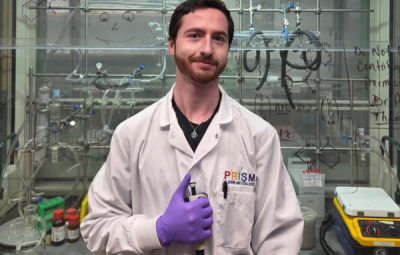

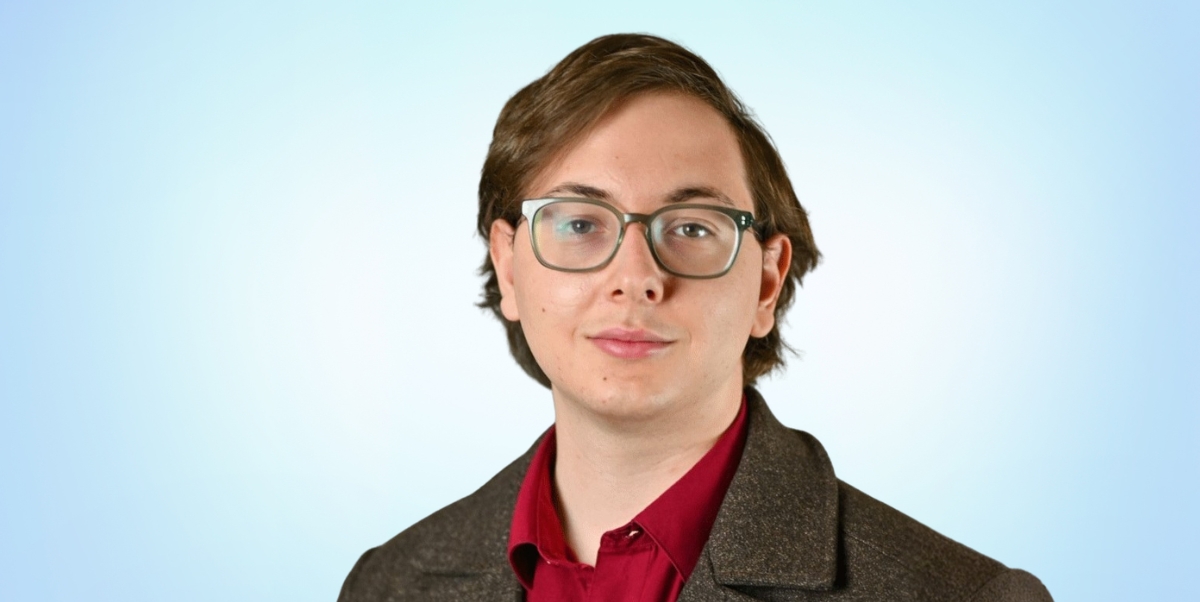
Marcellino Rau ’27 Researches Epigenetics & Breast Cancer
Major: Cell and Molecular Biology
Mentors: Molecular Biology Associate Professor Lissette Delgado-Cruzata, Ph.D., Mathematics and Computer Science Associate Professor Hunter Johnson, Ph.D.
Programs: Program for Research Initiatives in Science & Math (PRISM), the Honors Program, CUNY Inclusive Economy Initiative (CIE)
Internship: Research and Investment Intern, Royalty Pharma through Project Onramp
Hometown: New York, NY; Rome, Italy
Career Aspiration: Clinician/Scientist
What was life like before John Jay College?
I came from a town outside of Rome called Bracciano. I lived there most of my childhood. It was a “rural-ish” town. My close friend had a farm, and we would help him on it. Bracciano was very quaint. My parents tried to give us a lot of activities outside of the basic education offered. My dad would teach me, my twin brother, and my older sister piano and make sure that we saw our grandparents, who lived in Rome, to learn Italian history and culture. At Christmas time, we’d get panettone and pandoro. My mother taught me how to cook pizza, and we still have a lot of our family recipes.
When I was around six years old, my dad got a job at Condé Nast in New York City as a software engineer. He really enjoyed life in New York and wanted us to join him. So, my siblings, mother, and I came to New York when I was seven. Going from Italian to learning English was definitely a challenge, but we all just jumped right into a very chaotic, fun, New York lifestyle. First, we lived in Manhattan and then we moved up to Dobbs Ferry in Westchester. It’s funny now, after living in the U.S. for 15 years, when I go to Italy, I’m known as the American, and when I’m here in the States, I’m known as the Italian. I now consider myself both and I am a proud immigrant.
Why John Jay?
I actually transferred to John Jay from a private liberal arts college in Connecticut. I was a double major in biology and political science, but I didn’t find my biology classes very impressive. There wasn’t much attention being paid to the biology department and it was also costing me and my family an enormous amount of money to attend the school. I decided to transfer to John Jay for three reasons: It’s very well-funded, affordable, and my sister went to John Jay and she made a lot of friends at the College. Through her, I saw that John Jay was a beautiful place to be, with a diverse student body, and comprehensive support systems and programs for science students—like PRISM. Because criminal justice work involves forensic science, biology, and chemistry-related work, there’s a lot of networking in the science department, which I really appreciated.
What sparked your passion for science?
When I was younger, my parents used to give me books called The Mad Scientist. They were written in a comic-book, hyperbolic style for kids, but also talked about famous scientists like Louis Pasteur, Albert Einstein, and J. Robert Oppenheimer. In middle school, I had a really good biology teacher who introduced me to genetics and captivated my attention with different scientific concepts like phylogenetic trees. Also, in 2016, my grandfather was diagnosed with a glioblastoma, which is a very aggressive type of brain cancer. He passed away about a year after the diagnosis. My grandfather did not die from the cancer itself but from bronchitis related to the treatment. The chemotherapy weakened his immune system. Understanding that made me want to research treatments that prioritize medication that would be helpful to each individual patient.
How has your mentor helped to put you on the path to success?
My mentors have always pushed me to be autonomous. They made me see that I had to do more than hands-on lab work. The lab skills are very important, but my mentors made me aware of the fact that I should also be planning out research, figuring out what kind of equipment was needed, and coming up with the specific processes required to take theoretical concepts to the bench. Dr. Delgado-Cruzata showed me how to push and advocate for myself and my research. Both Dr. Delgado-Cruzata and Dr. Johnson would be there to guide me when I needed them, but they helped me understand that I had to take the initiative in my own research.
What is the focus of your research with Dr. Delgado-Cruzata?
For almost two years, we’ve been working with this sugar found in green tea. We’ve seen in other studies that it helped prostate cancer patients go into remission, survive the cancer, and get better. What we don’t know is if that’s applicable to breast cancer because it functions differently from prostate cancer. What we want to research is whether this sugar has an effect on the epigenetics of breast cancer. Our study focuses on how the sugar affects the ways in which different genes are expressed within different cell lines. We looked at the ability of the DNA to activate different portions of itself.
Another study that Dr. Delgado-Cruzata and I are working on involves analyzing the ways in which Afro-Brazilian breast cancers differ in gene activation. The cells can change depending on environmental factors, genetic factors, and even generational trauma. Populations that have had a lot of oppression, like the Afro-Brazilian people who experienced enslavement, have experienced a very big stressor. We’re looking at how these different factors influence the epigenetics of Afro-Brazilian people and the relation to breast cancer. We know that people with African ancestry have much higher rates of triple-negative breast cancer than people with non-African ancestry. For the study, we are collaborating with a cancer research lab in Brazil. Dr. Delgado-Cruzata got samples from 48 different patients. Then we took the cells and did genetic analysis on them directly. I’m in charge of doing the genetic data analysis, using my computer science skills from Dr. Johnson, to do bioinformatic analysis that shows the different ways these genes are activated and deactivated, and how they’re related to the profile of triple-negative breast cancer cells. This is important work because triple-negative breast cancer is very aggressive and extremely hard to treat because it’s not responsive to hormonal treatments or HER2 genetic treatments. That’s why this type of breast cancer, which is much more prevalent in populations with African ancestry, has a higher mortality rate compared to other types of breast cancer.
What do you hope your research does for society?
I want to help contribute to the epigenetic treatment of triple-negative breast cancer. If we apply the same drug across a vast population, we’re going to have a lot of different results. Being able to personalize the treatment based on someone’s ancestry or their epigenetic profile would be a massive win for personalized medicine. I also want to help better understand triple-negative breast cancer in general. I want to see what its weaknesses are and potentially what markers we can use to better diagnose and approach it.
How has CIE and PRISM enhanced your education?
My CIE advisor, Julie Kiss, and PRISM Associate Program Director Edgardo Sanabria-Valentín, Ph.D., helped me a lot. They’re constantly sending me internship opportunities, suggesting different kinds of lectures I could attend, recommending places where I could present my research, and giving me resume and interview guidance. The PRISM team is always there for me. They have given me spectacular advice and resources. If it wasn’t for PRISM, I don’t know where I’d be today. It can’t be overstated how much PRISM has helped shape me and elevated my education.
Where do you see yourself in 10 years?
I’d like to pursue an M.D./Ph.D. I want to spend my time between working in a practice, seeing patients, and working in a lab, performing research on translational medicine—which essentially bridges the ideas in academic research and the trials in clinical research. Translational medicine involves taking the concepts from academic research and finding ways to test them in clinical research. To do this type of work, you need an M.D. and a Ph.D. I want to have a hands-on practice where I can care for people in a nurturing way, but I also want to explore intellectual, scientific ideas. Working in translational medicine would allow me to see the positive impact the research has on people. It speaks to the two sides of myself.
Please finish this sentence: Because of John Jay…
I am a scientist. John Jay has helped me find the intersection between politics, science, and community.