

2026 Research & Creativity Expo Features State-of-the-Art Student Research
One of the most anticipated events of the spring semester is our annual Research & Creativity Expo. This exhibition gives our talented students a meaningful platform to share their insightful research. These projects represent months, and in some cases years, of research guided by trusted mentors.
The projects are presented in many formats, but all hope to change perspectives, expand knowledge, and ignite justice-focused conversations. “Each year, our Research & Creativity Expo opens by showcasing the vibrant work of our arts and performance communities while also honoring the faculty and administrative mentors who make it all possible,” says Bettina Muenster, Assistant Director, Office for Student Research & Creativity. “From there, the Expo unfolds over 10 days. As the largest event series of its kind across all CUNY campuses, the Expo continues to set the standard as a model for innovation and interdisciplinary collaboration.”
This year’s Expo runs from April 29 – May 8. It has approximately 400 students participating, with all majors and minors represented, and more than 120 faculty and staff members providing mentorship. Check out these four noteworthy examples of our 2026 Research & Creativity Expo presenters.

Alexandra Cortese ’26
Majors: Law & Society
Minor: English
Hometown: Staten Island, NY
Programs: Honors Program
Mentors: Law & Society Associate Professor Jean Carmalt, Ph.D.; Law & Society Associate Professor Jamie Longazel, Ph.D.
Career Aspiration: Attorney
What was your research project about?
My research project is about how the First Amendment rights of student journalists are limited. My role as both a student journalist and editor-in-chief of The John Jay Sentinel inspired me to investigate the topic of free speech because few people realize how significant our First Amendment right is and how easily it can be limited.
What was your research method and findings?
My research method was semi-structured qualitative interviews. I found that even though student journalists may not directly encounter censorship, the possibility of it can cause them to self-censor as a precaution. I learned that self-censorship can be subconscious and that is the most dangerous aspect of it.
How did your mentor help you succeed in your research?
My formal mentor for this project was Professor Jean Carmalt, but Professor Jamie Longazel undoubtedly helped me sharpen my findings as well. Professor Carmalt helped me think about the legal aspects of my project, while Professor Longazel helped me stay grounded and tackle my research in a way that was organized and impactful.
What do you hope people learn from your presentation?
I hope that my presentation helps other people realize that self-censorship can happen subconsciously and motivates them to be more outspoken.
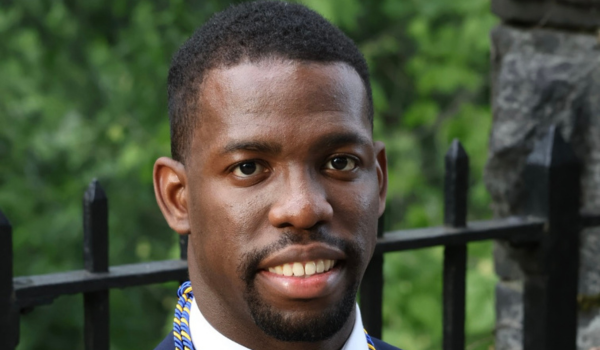
Christopher McGrowder ’26
Degree: M.S. in Forensic Science with a concentration in Toxicology
Hometown: Queens, NY
Programs: PRISM, CSTEP, CIE
Mentor: Forensic Science Associate Professor Marta Concheiro-Gusian, Ph.D.
Career Aspiration: Professor of Toxicology and Pharmacology/Forensic Toxicological Analyst
What was your research project about?
My research focused on the stability issues of psilacetin, a synthetic prodrug that’s becoming more popular as a therapeutic and recreational psychedelic. Because psilacetin is very unstable in a biological environment and quickly breaks down into psilocin, another psychoactive compound, it is challenging to detect accurately in forensic toxicology. My project aimed to find the best way to preserve psilacetin in blood so forensic analysts can distinguish it from other substances.
What was your research method and findings?
The method involved testing various concentrations of ascorbic acid in sheep plasma to find the optimal stabilization level. Afterward, the optimal concentration was tested across different blood backgrounds—including human, bovine, and sheep blood—using several preservatives. The results showed that both the concentration of ascorbic acid and the specific preservative used was critical. Two hundred and fifty millimolar of ascorbic acid successfully stabilized psilacetin in bovine and sheep blood, as well as in human blood preserved with sodium fluoride/potassium oxalate. One of the most striking discoveries was that without any ascorbic acid, psilacetin underwent complete and instantaneous breakdown in less than five minutes across all tested species.
How did your mentor help you succeed in your research?
I am deeply grateful to my mentor, Dr. Marta Concheiro-Guisan, whose guidance was crucial in helping me develop a practical and thorough method for this project. She taught me how to handle complex toxicological analysis and data interpretation to find real-world solutions. In addition to the theory, she provided hands-on training in advanced instrumentation techniques. Dr. Concheiro-Guisan was remarkably patient and actively involved in every part of the research, from testing different concentrations of ascorbic acid to analyzing blood preservatives. Most importantly, she constantly encouraged me to become part of the larger scientific community. Her support is why I am presenting my work at the Expo and attending conferences to share our findings with other professionals.
What do you hope people learn from your presentation?
I hope people understand that maintaining analyte integrity in forensic samples requires very specific chemical environments. I want people to see how these forensic techniques allow us to distinguish between different synthetic drugs, which is vital for accurate toxicological reporting.

Atreya Vaughn ’26
Majors: Anthropology and Crime, Deviance, and Culture
Hometown: Detroit, MI
Programs: Honors Program; Anthropology Club
Mentors: Anthropology Professor Shonna Trinch, Ph.D.; Adjunct Professor Barbara Cassidy
Career Aspiration: Attorney
What was your research project about?
My research looked at the cultural background of rape and sexual abuse, focusing on how these acts have been used as a tool of power. I explored how rape culture forms and how societies sometimes accept or downplay sexual violence. I also studied how cultural beliefs, politics, and social systems affect how victims are treated and whether offenders face consequences.
After finishing the research, I used what I learned to create a short play about a woman who was sexually abused as a child and how that experience impacts her and her family across generations.
What was your research method and findings?
My research primarily relied on the qualitative methods I learned as an anthropology major, including the analysis of academic literature, historical case studies, and cultural narratives. I examined how sexual violence appears in media and cultural traditions across the world, as well as archives and legal systems.
One of the main findings of my research was that rape culture is often reinforced through social norms that normalize violence or silence victims. I also found that institutions sometimes fail to adequately address these crimes of sexualized violence, contributing to a lack of accountability.
How did your mentors help you succeed in your research?
Both of my mentors helped me succeed by deconstructing the many contexts and categories that sexual violence can fall under. They encouraged me to examine the issue from multiple perspectives, and they helped me understand both the survivors’ experiences and the social factors that influence perpetrators. One important point they stressed was that perpetrators exist within communities as family members or peers, which contributes to why these acts are sometimes minimized or protected. This guidance helped me approach my research with more nuance and empathy while recognizing how common sexual violence is and why it is important to study the cultural conditions that allow it to persist.
What do you hope people learn from your presentation?
I’d like for people to leave my presentation with a greater understanding of how rape culture develops and why it persists in many societies. I want conversations about rape to be less uncomfortable. The only way to do that is to talk about it.

Caitlin “Cat” Sanders ’26
Degree: M.A. Forensic Psychology
Hometown: Boone, North Carolina
Mentor: Psychology Professor Philip Yanos, Ph.D.
Career Aspiration: Forensic Psychologist
What was your research project about?
My thesis examines how mental health courts operate across the five boroughs of New York City and how individuals with mental illness are referred to and processed through these specialized court programs. The project explores how these courts function as alternatives to traditional criminal case processing. I was drawn to this topic because mental health courts represent a key effort to address the intersection of mental illness and the criminal justice system. Studying how these courts function in New York City can help inform ways to improve access to treatment and support for justice-involved individuals.
What was your research method and findings?
Using administrative and court-related data from mental health courts across the five boroughs, my research analyzes patterns in eligibility, participation, and outcomes among individuals referred to these courts. The goal was to better understand how these courts are used and who is most likely to benefit from them. Through this research, I learned how complex the intersection between the mental health and criminal justice systems can be. The project highlights the importance of specialized court programs designed to address both legal and clinical needs.
How did your mentor help you succeed in your research?
Dr. Philip Yanos guided me in refining my research questions and navigating the process of obtaining and analyzing court-related data. His mentorship helped ensure the project remained both methodologically rigorous and grounded in real-world forensic practice.
What do you hope people learn from your presentation?
I hope people leave with a better understanding of how Mental Health Courts in New York City work and why they are an important response to the overrepresentation of individuals with mental illness in the criminal justice system.